Admiral Mohamed Tahin, Inspector of the Royal Moroccan Navy, affirmed that Morocco, under the esteemed directives of His Majesty King Mohammed VI, the Supreme Commander and Chief of General Staff of the Royal Armed Forces, continues to enhance partnerships, promote maritime security, and foster peace, stability, and regional prosperity. He emphasized that the Kingdom remains fully committed alongside its partners to create an environment based on trust, exchange, and cooperation, contributing to the enhancement of maritime security both in Africa and beyond.
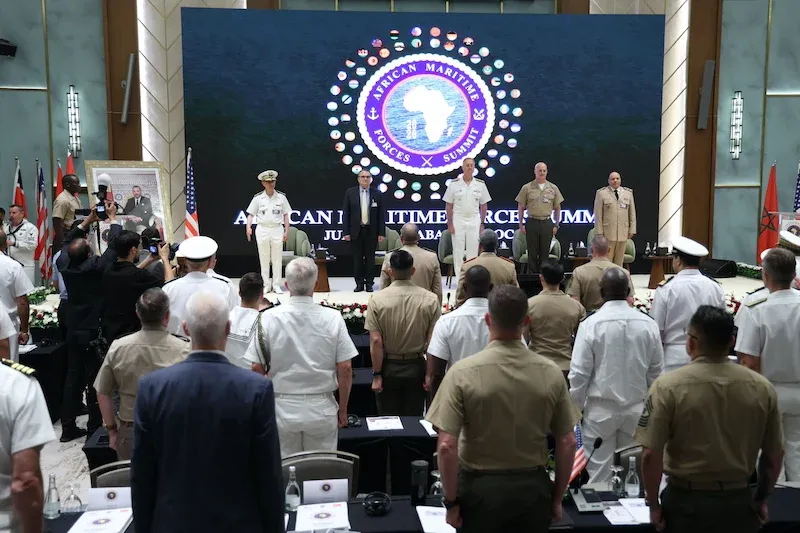
In his address during the opening of the fourth annual African Maritime Forces Summit (AMFS 2026), which commenced today in Rabat in partnership with the Royal Armed Forces and the U.S. Navy in Europe and Africa, along with the U.S. Marine Corps, Tahin noted that this year's summit is held at a particularly significant moment in the history of relations between Morocco and the United States, coinciding with the celebration of the 250th anniversary of American independence.
Tahin continued to elaborate during his speech, attended by naval officials from over 40 African nations and 20 countries outside the continent, including Saudi Arabia, the UAE, South Korea, Brazil, Spain, and others, that this historic event holds special importance for Morocco, as it was over two centuries ago that Morocco became the first nation to recognize the independence of the United States, thus laying the foundation for one of the oldest continuous diplomatic relationships in history. Since then, these exceptional ties have evolved into a strategic partnership based on mutual respect, shared values, and common interests.
Strategic Partnership
In this context, the Inspector of the Royal Moroccan Navy clarified that the Moroccan-American partnership has been marked by significant milestones, including the U.S. decision in December 2020 to recognize Morocco's sovereignty over its Sahara, a historic decision that enhances the strategic dimension of relations between the two countries as well as the mutual trust between them. He indicated that the participation of the Moroccan Navy frigate 'Mohammed VI' in the celebrations marking this historic anniversary serves as a strong symbol of the vitality of this friendship and the close ties that bind them.
Tahin further stated that through the African Maritime Forces Summit and other training activities and international exercises, such as ‘African Lion,’ ‘Obangame Express,’ ‘Phoenix Express,’ and ‘Cutlass Express,’ our American partners from the U.S. Africa Command, the U.S. Navy in Europe and Africa, and the U.S. Marine Corps in Europe and Africa have demonstrated their commitment to supporting dialogue and developing capacities among African naval forces, contributing to operational compatibility, readiness, and regional stability. He emphasized that these initiatives provide valuable opportunities for African nations to exchange experiences, develop common approaches, and enhance their capacity for collective response to shared maritime challenges.
Moreover, the Moroccan military official noted that the maritime spaces of Africa hold immense strategic importance; they represent vital routes for international trade, sources of economic opportunities, and essential areas for regional stability and sustainable development. However, these maritime areas are also vulnerable to a mix of traditional and emerging threats that transcend borders, such as illicit trafficking, piracy, illegal, unreported, and unregulated fishing, environmental changes, hybrid threats, and maritime terrorism.
Collective Responsibility
Tahin asserted that effectively responding to these challenges requires not only capable forces but also dialogue, trust, and collective action. He highlighted that no nation can face these challenges alone; the maritime environment demands collective vigilance, coordinated action, and continuous cooperation among naval forces, governmental agencies, regional mechanisms, and international partners.
The Moroccan military official mentioned that innovation plays a crucial role in enhancing awareness of the maritime domain, improving operational effectiveness, and preempting emerging threats. Emerging technologies, artificial intelligence, unmanned systems, satellite surveillance, and advanced information-sharing platforms are transforming the way naval forces operate and collaborate. He stressed that the future will belong to those who can not only possess technology but also innovate, adapt, and convert information into a strategic advantage, and thus it is our responsibility to ensure that innovation becomes a tool for collective advancement, supported by education, research, and partnerships.
Additionally, the Inspector of the Royal Moroccan Navy referred to the launch of a joint initiative between the Moroccan military and the U.S. Africa Command last week aimed at establishing an 'African Multidisciplinary Training and Experimentation Center' to enhance military training. He stated that this initiative will provide valuable opportunities for African countries to bolster their capabilities in combating terrorism and countering threats, focusing on low-cost and scalable solutions for regional security operations and improving their collective response capacity to common maritime challenges.
Tahin concluded by asserting that the shared objectives are clear: to encourage the emergence of a technologically advanced African maritime community, based on trust, cooperation, and mutual support, achieving peace, stability, and prosperity for the entire continent. Under the enlightened vision of His Majesty King Mohammed VI, the Kingdom of Morocco has consistently promoted an integrated approach to maritime security that combines defense, development, and cooperation. He reiterated that His Majesty has underscored the strategic importance of Africa's Atlantic and maritime domains as engines of prosperity and platforms for solidarity among African nations.
The city of Rabat is hosting the fourth annual African Maritime Forces Summit (AMFS 2026) from July 20 to 24, bringing together senior African naval leaders alongside their counterparts from Europe, the Americas, and the Middle East to discuss ways to address increasing threats in vital waterways and achieve a stable maritime environment relying on innovation and modern technologies.
As reported by hespress.com.