

Upcoming Partial Solar Eclipse in Morocco
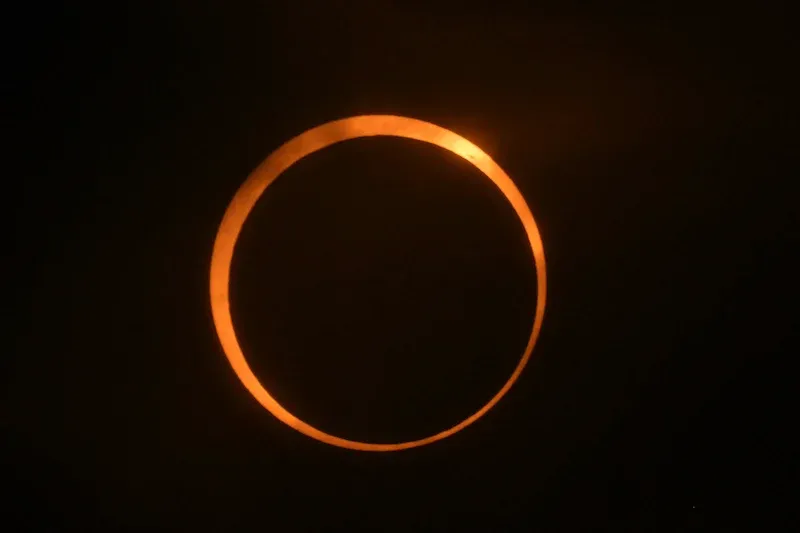
On the evening of Wednesday, August 12, Morocco will witness a captivating partial solar eclipse, where the moon will obscure a portion of the sun's disk just before sunset. Various regions across the country will have the opportunity to observe this astronomical phenomenon, with the level of obscuration varying depending on geographic location. This event is anticipated to be particularly striking as it coincides with sunset, offering a unique visual experience for spectators.
Viewing Details and Safety Precautions
The eclipse will be total along a narrow path that stretches from Northern Russia, passing through the Arctic Ocean, Greenland, and Iceland, before reaching parts of Northern Spain and Portugal, where the moon will completely cover the sun for a brief period. However, the partial eclipse will have a much wider visibility range, expected to include large portions of Europe and North Africa, including Morocco, as well as parts of North America and areas over the oceans, according to data from NASA.
This celestial event has sparked significant interest among astronomy enthusiasts and researchers, as it presents a chance to observe a remarkable sky phenomenon and witness the transformations that will occur on the sun's disk, especially in regions with the highest levels of obscuration. Mazen Younes, a member of the British Astronomical Association, noted that the most dramatic views will occur in the Iberian Peninsula, particularly in Spain, where the sun will entirely disappear for several minutes along the path of the moon's shadow.
In Morocco, although the eclipse will be partial, it promises to deliver a stunning spectacle as locals will have the rare opportunity to see the sun gradually transition into a low-hanging golden crescent on the horizon. The extent of the sun's obscuration will vary from one Moroccan city to another, with the highest levels of obscuration anticipated in cities like Tangier and Tetouan. For instance, in Tangier, the partial eclipse is expected to begin around 6:44 PM local time, peaking at approximately 7:40 PM with over 92% of the sun's disk obscured. In Agadir, the eclipse will start around 6:54 PM, reaching its peak at about 7:49 PM, with nearly 80% of the sun being obscured.
Residents in northern Morocco will witness a breathtaking transformation, as the circular sun they are accustomed to seeing will morph into a slender crescent, appearing close to the western horizon. One of the unique aspects of this eclipse in Morocco is its timing, as it will coincide with the sunset, allowing for a stunning blend of sunset colors with the eclipsed sun, provided that the weather is clear and there is an unobstructed western horizon.
In terms of safety, viewers should take precautions to protect their eyes, as looking directly at the sun can cause serious damage, even during a partial eclipse. It is advised to use specialized solar viewing glasses or indirect viewing methods, avoiding regular sunglasses and any unapproved devices for solar observation.
Furthermore, the Canary Islands Astrophysics Institute (IAC), in collaboration with Mohammed VI Polytechnic University (UM6P) in Morocco and the National Solar Observatory in the United States, has launched a project called "Neat" aimed at training joint scientific teams and creating a network of telescopes. This initiative includes organizing scientific and outreach activities in Valencia, Spain, featuring experts in solar physics, and will culminate in a live observation of the eclipse on August 12, documenting its phases with photos and data while providing scientific explanations to the public.
As reported by hespress.com.
