
Insights from the Police Report on Ceuta's Migration Crisis
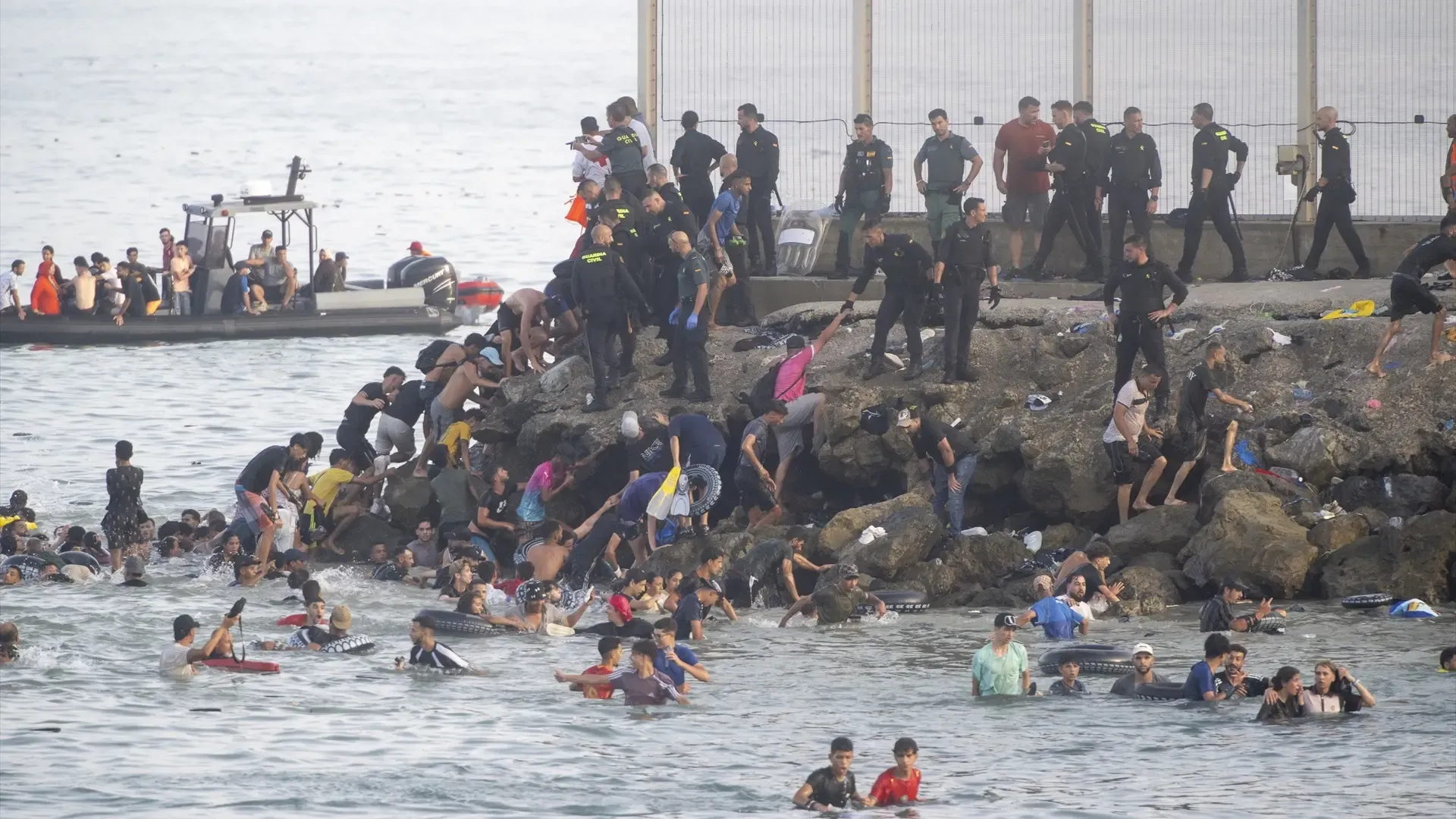
A recent police report submitted to the Spanish National Court has implicated Moroccan gendarmes and undercover police as "active subjects" involved in the mass influx of migrants into Ceuta. The 55-page document accuses Rabat of having a minimal presence of its security forces in the region and indicates that the agents present executed a "directed guidance of the masses towards crossing points.” This operation was described as a "planned action" aimed at collapsing Spain's border management system and effectively eliminating its capacity to respond.
The report, obtained by 20minutos., directly contradicts claims made by the Spanish government since the onset of the crisis. It dismisses the notion that human trafficking mafias were behind the events of late July and counters the Interior Ministry's statements asserting that there is no report attributing the planning or execution of the incidents on July 30 and 31 to Moroccan security forces.
Moreover, the document highlights a "police permissiveness in Morocco" and notes that on July 30, there were no serious attempts to reduce, disperse, or move people away from the border perimeter. It describes the Moroccan security forces as exhibiting a "tolerant, almost active" attitude, while migrants behaved with "relative calm" and a sense of impunity, moving freely without fear of consequences. Videos and interviews shared on social media reportedly depict behaviors consistent with facilitating irregular immigration, including scenes suggesting monitoring and control of the entry process. Many interviewed migrants recounted that Moroccan police provided them with directions to access the area near El Tarajal instead of other entry points.
Analysis of the Migration Process and Its Consequences
The National Immigration and Borders Center (CENIF) of the National Police views the events as a "process with corresponding phases"—preliminary, central, and subsequent. They emphasize that this is not an incidental event connected to an occasional or spontaneous factor. The document was sent to María Tardón, the instructor at the National Court, who will determine whether to initiate a judicial investigation. Following the massive entry of migrants, the report indicates a significant increase in Moroccan police and military presence at the Ceuta border, including heavy vehicles and roadblocks.
The police identified "concurrent elements" with previous entry processes in 2021 and 2025, noting that prior experience has led to improvements, making this action significantly more complex and orchestrated. The report suggests that the migratory intent was merely a "formal cover" to facilitate and direct a massive flow of individuals to the Ceuta border, as most migrants did not intend to remain in Spain.
The report also highlights that following the entry of tens of thousands of migrants, there were messages—some even at an official level—justifying Morocco's territorial claims that question Spain's sovereignty over Ceuta and Melilla. The high level of task specialization observed is noted as being beyond the capacity of any known criminal structure operating in the region.
Based on various videos and open-source images, the report identifies several undercover agents who cooperated with the gendarmes and were tasked with "on-the-ground monitoring." In its concluding analysis, the report examines the multiple dimensions of the impact caused by the mass entry, including an "institutional impact" that overwhelmed prevention, containment, response, and assistance capabilities. It also addresses the "impact on civil society," discussing issues ranging from limitations on rights to sociopolitical agitation, misinformation, trust in institutions, the deterioration of public safety, and strain on the healthcare system.
According to CENIF, all these factors contribute to a "geopolitical collateral effect" that harms Spain's image and induces international questioning due to the circumstances created. It also notes a "political destabilization internally" and highlights a critical concern regarding the Centro Nacional de Inteligencia (CNI) and its failure to detect these developments, characterizing the escalation as what could be termed an "offensive counter-intelligence action of the manual."
As reported by 20minutos.es.