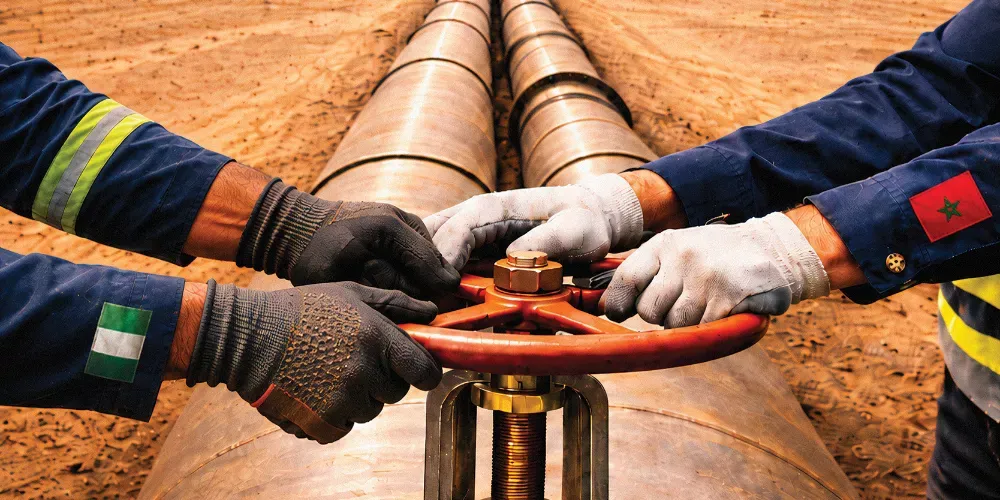

In a significant advancement for energy cooperation in Northwestern Africa, the heads of state from the Economic Community of West African States (ECOWAS) convened in Freetown, Sierra Leone, on July 19 to sign the Intergovernmental Agreement (IGA) for the Africa-Atlantic Gas Pipeline (AAGP). This landmark agreement serves as the foundational document for a project that has been a decade in the making and aims to transport natural gas from Nigeria to Morocco and subsequently to European markets. Spanning an impressive 7,000 kilometers, with 5,100 kilometers located offshore, the AAGP will facilitate gas transit through thirteen participating nations, ensuring a seamless regulatory and tax environment for gas transportation.
The IGA marks a pivotal step forward in the project’s implementation phase, establishing a legal framework that enables the establishment of governance structures, secures financing estimated between $20 billion and $25 billion, and sets the stage for a final investment decision anticipated by the year's end. Moha Ouali Tagma, Morocco’s ambassador to Nigeria and ECOWAS, articulated the significance of this agreement, emphasizing that it reflects a collective ownership among West African states and elevates the project to a supranational level. Notably, Morocco and Mauritania, while not ECOWAS members, participated as observers and are expected to sign the agreement in Rabat following the summer recess.
Decade of Development: A Layered Approach
The signing in Freetown is the culmination of ten years of persistent negotiations, agreements, and studies spearheaded by Morocco and Nigeria. The genesis of the project can be traced back to December 2016 when King Mohammed VI of Morocco and Nigerian President Muhammadu Buhari signed a foundational agreement in Abuja during the King’s African tour. This initial agreement was complemented by a partnership between their respective sovereign wealth funds and subsequently entrusted to their national energy companies to undertake feasibility studies. Over the ensuing years, these studies confirmed the project's viability, with a positive outcome reported by 2018 and detailed engineering designs completed by March 2024. The project has seen a steady increase in participation from the national oil companies of transit countries, with Togo being the most recent participant.
Significant milestones were reached in November 2024 when ECOWAS energy ministers approved the text of the IGA, transitioning from the initial nomenclature of the “Morocco-Nigeria Gas Pipeline” to its current continental designation, thereby incorporating existing regional gas projects into the new framework. Although the heads of state missed their initial deadline for signing the agreement, the Freetown meeting served as a practical assembly point for all ECOWAS members involved in the initiative. Gas flow is projected to commence around 2030-2031, progressing through the northern and southern sections, with full operational capacity expected by 2036, leveraging Nigeria’s vast reserves of 6,000 billion cubic meters of natural gas, the largest in Africa.
Strategic Implications and Future Prospects
Ambassador Tagma foresees the AAGP as a transformative project that will foster energy-sharing and infrastructure collaboration across North Africa, drawing parallels to the European integration model initiated by the European Coal and Steel Community. This historical perspective underscores the vision behind the pipeline, which aims to enhance regional cooperation and economic interdependence. While Algeria promotes its own Trans-Saharan Gas Pipeline project, skepticism surrounds its feasibility due to security concerns, particularly regarding the ongoing instability in the Sahel region. In contrast, the AAGP corridor is perceived as relatively insulated from conflict, positioning it as a more attractive option for investment and development.
As Europe seeks to diversify its energy sources and reduce dependence on Russian gas, the AAGP could play a critical role in supplying natural gas to European markets. The anticipated connection between the AAGP and the existing Maghreb-Europe Gas Pipeline will facilitate this integration, potentially reshaping energy dynamics in the region. While the timeline for the AAGP’s operational commencement may not align perfectly with the immediate needs of the European market, it is widely recognized that a second African connection to Europe would significantly alter the energy landscape.
Looking ahead, attention is now focused on Morocco, where the formal signing of the IGA is expected to take place in Rabat, involving key stakeholders including the Nigerian president and the Mauritanian president, signaling a robust commitment to the project. This signing will also mark the establishment of the project’s governing institutions, which will oversee all aspects of financing, procurement, and construction. Despite the challenges related to financing, with estimates hovering around $25 billion, ongoing discussions with international financial institutions indicate a strong commitment to bringing this ambitious project to fruition.
As reported by telquel.ma.