
In the Army of Africa, a young Francisco Franco began to shape his nebulous vision of Spain's revival and his own destiny to restore its former glory. Ceuta, a narrow strip of land where the Mediterranean meets the Atlantic, has recently gained attention in European news. This exclave, separated from the Spanish mainland by the Strait of Gibraltar, has been a focal point of Spain's outlook towards Africa for over five centuries. The narrative of Spain’s African century—a saga of its ascension, dreams, and subsequent decline—can be traced to this geographical and historical crossroads. Throughout the early 20th century, Morocco occupied a complex space in the Spanish psyche, symbolizing both the last refuge of an evaporating imperial dream and the launchpad for the Nationalist uprising in the summer of 1936.
Historians have long noted the emergence of 'Two Spains' in the 19th century: one faction, progressive and aligned with Enlightenment ideals and the Industrial Revolution, and another, deeply Catholic and nostalgic for its medieval past and imperial dominion in the Americas. This dichotomy came to life following the catastrophic events of 1898—the loss of Cuba and the Philippines to the United States. This defeat not only instigated a profound sense of imperial decline but also triggered a national crisis of identity and self-worth. The phrase 'Spain without Cuba' encapsulated the sentiment of inevitable decadence that would follow. Unlike previous territorial losses, the forfeiture of these colonies was perceived as a collective national tragedy, a wound felt deeply by the Spanish populace.
Despite this setback, the Spanish elite clung to their imperial aspirations, driven by the prevailing ethos of an age defined by colonial conquest. In a bid to reclaim military honor lost in 1898, Spain engaged in the European partitioning of north-west Africa, clashing with Riffian tribesmen in a series of drawn-out conflicts known as the Rif Campaigns. The British, keen to curtail French ambitions in the region, invited Spain to join the consortium overseeing Morocco's Sultan, Abd al-Aziz, in 1904. This alliance transformed Africa into both a psychological and military compensation for the lost empire, signifying Spain's re-emergence among the great European powers. Among those most invigorated by this endeavor was a young cadet from Toledo's military academy, Francisco Franco, who would go on to mold his military and political identity during his time in Africa.
When the Spanish Protectorate of Morocco was established, it added only a marginal portion of land—five percent—to Spain's existing territories of Melilla and Ceuta, the latter having been Spanish territory since 1668. The Protectorate spanned 10,800 square miles and housed around 400,000 residents, comprising a segment of the Mediterranean coastline and a limited stretch of the Atlantic. The fervent nationalism at home hailed the young King Alfonso XIII with the title 'Africanus,' reminiscent of the Roman general Scipio, who had famously defeated Carthage.
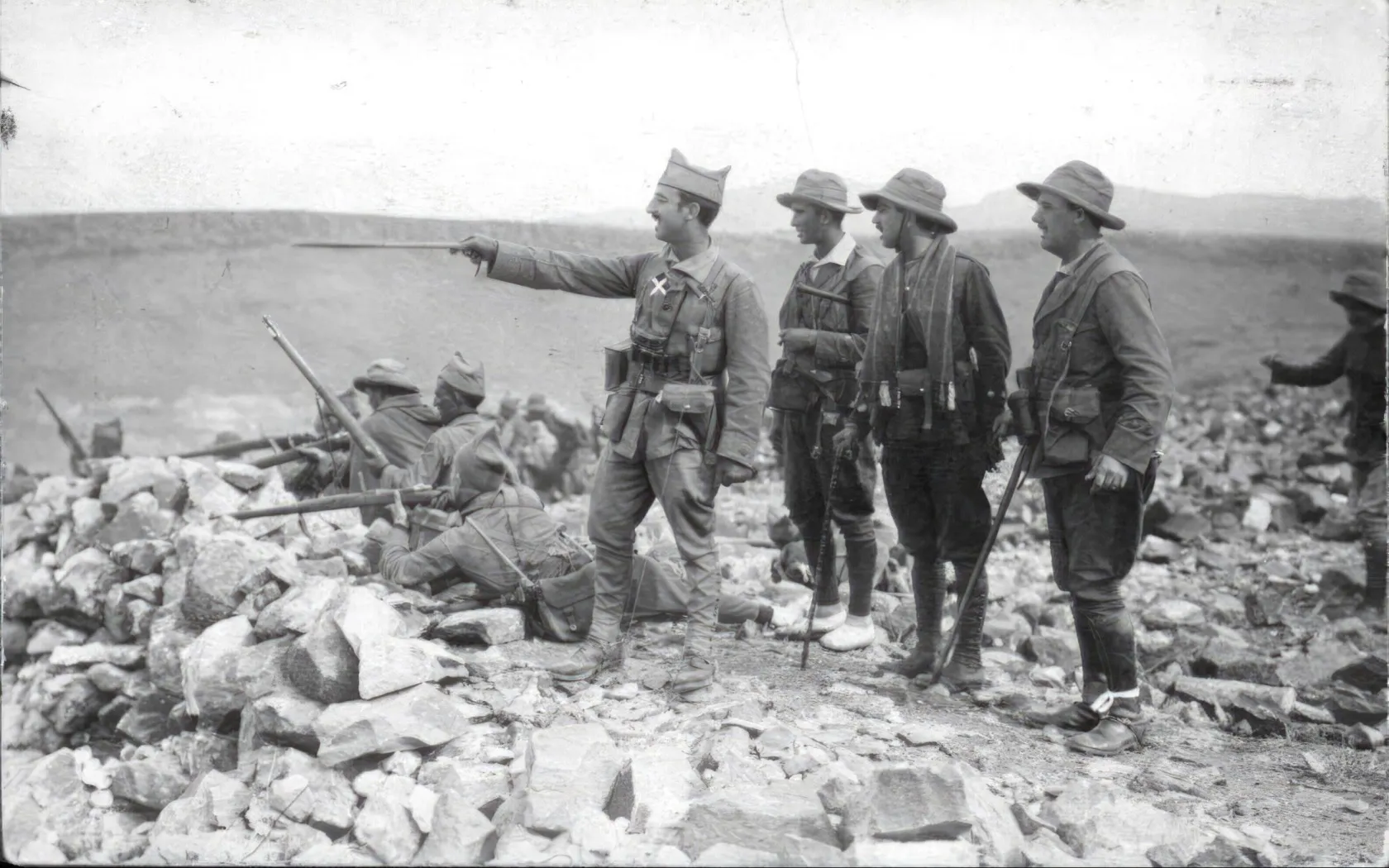
By 1912, Franco had aligned himself with the _Africanistas_, an elite military corps that romanticized death in service of the nation. It was within this Army of Africa that Franco articulated his vague notion of Spain's grandeur and his role in its restoration, stating years later, 'My years in Africa live within me with indescribable force. There was born the possibility of rescuing a great Spain. Without Africa, I can scarcely explain myself to myself.'
Franco emerged as a pivotal figure in the Spanish Legion, established in 1920, which drew its ethos from the martial codes of the Japanese samurai—honoring duty, honor, and sacrifice. This period of interwar Europe saw republics crumbling under military regimes, with only France and Britain maintaining a semblance of liberal democracy. Spain had declared the Second Republic in 1931, and amid this turmoil, young officers in Africa began blaming politicians for the perceived betrayal leading to the 1898 losses. They fostered a myth that the military was the rightful redeemer of Spain’s lost greatness, transforming Morocco into a breeding ground for the impending military conspiracy. Alongside Franco were key figures like General Mola, who coined the term 'fifth column,' and José Millán-Astray, the founder of the Legion. The army raised to conquer Morocco would eventually turn against Spain itself.
The opportunity to challenge the fledgling republic arose in the politically charged summer of 1936. On July 17, the Army of Africa stationed in Melilla revolted, marking the inception of the Spanish Civil War (1936-39), a precursor to the Second World War. Within hours, the heavily fortified protectorate was under Nationalist control, and Franco was declared the leader of the uprising in Africa. From the Protectorate, the Nationalists launched assaults on southern cities like Seville, Cádiz, and Algeciras, progressing northward towards Madrid. The failure to mobilize the Rif against Franco became one of the contributing factors to the Republic’s downfall, as noted by George Orwell, who remarked on the lack of initiative to 'declare Morocco liberated.'
Following Franco's rise to power in 1939, Morocco maintained its significance in the regime's narrative until 1955, serving as a military launchpad, a reservoir of loyal troops, and a pillar of Spanish imperial pride. However, this narrative unraveled quickly. When John Foster Dulles, the US Secretary of State, who opposed European empires, visited Madrid, he made it clear that Spain's entry into the United Nations was contingent upon relinquishing its protectorate. Consequently, Franco ceded most of the territory to King Mohammed V a year later, retaining only a small enclave around Sidi Ifni on the Atlantic, which was eventually surrendered in 1969, alongside the desolate Spanish Sahara.
On November 6, 1975, as Franco lay dying, King Hassan II dispatched 350,000 Moroccan volunteers into the desert to demand its cession. This decisive act effectively ended the empire, coincidentally marking the demise of the man who had endeavored to resurrect it from the ashes of the 19th century. The remnants of empires linger at their peripheries, and in Spain's case, those remnants can still be found at Ceuta.
As reported by engelsbergideas.com.