Understanding the Strategic Significance of the Mountain Facility
Former U.S. President Donald Trump recently brought the Mountain Facility back into the spotlight of the ongoing confrontation with Iran, stating in an interview that the site could potentially face a significant strike directly at its front door. He further asserted that targeting this location is on Washington's agenda. However, this statement transcends mere political posturing, as it unveils a fundamental military dilemma. While it is feasible to bomb the entrances of a mountainous facility and disrupt access, ensuring the complete destruction of its internal chambers or neutralizing its potential nuclear capabilities poses a significantly different challenge. Experts believe that the facility may harbor deep tunnel complexes that could exceed the guaranteed reach of the most powerful U.S. bunker-busting bombs.
What is the Mountain Facility?
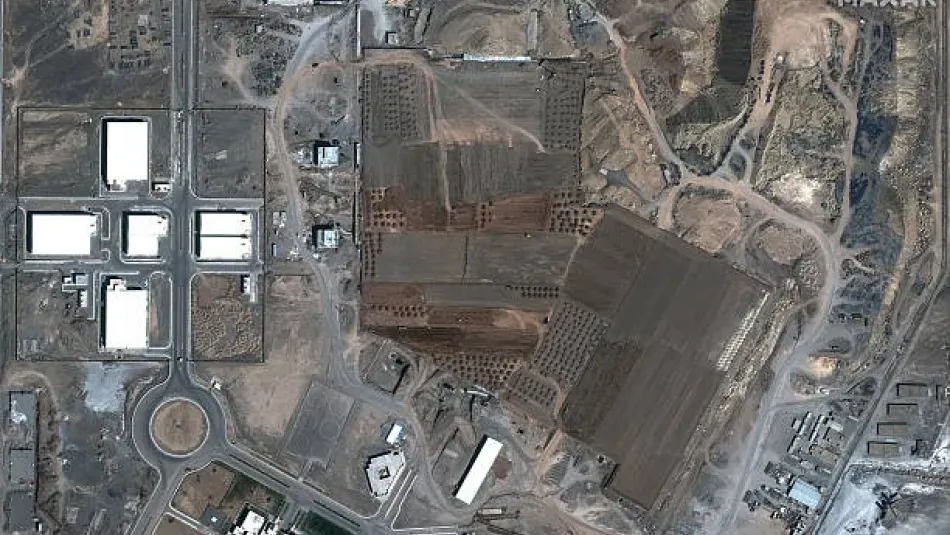
The Mountain Facility, colloquially referred to as "Pikax Mountain," is located approximately 1.6 kilometers south of the Natanz uranium enrichment complex. Iran began constructing this new facility in late 2020 following sabotage at the Natanz site, where centrifuge assembly buildings were targeted. At that time, Iranian officials announced their intention to build a larger and more modern facility inside the mountain, close to the original site.
Satellite imagery reveals both eastern and western entrances, along with additional tunnels in the vicinity, vehicle access routes, large piles of excavation debris, and a multi-layered security fence surrounding the mountain mass. Images captured in February 2026 indicate that some entrances are still being reinforced with concrete, rocks, and earth, alongside the presence of cement mixers, trucks, and heavy machinery. Analysts suggest that the ongoing construction indicates that the facility is not yet fully operational, although the movement of vehicles near the entrances might imply preparations for parts of the interior.
The specific function of the complex remains uncertain. While it may be designated for the assembly of centrifuges as claimed by Tehran, it is also spacious and fortified enough, according to some estimates, to store sensitive equipment or materials, or to host future enrichment activities. International Atomic Energy Agency (IAEA) inspectors have not accessed the site, and satellite images do not reveal any centrifuges or uranium stockpiles within. Thus, it is more accurate to describe it as a facility linked to the nuclear program, potentially hosting sensitive activities, rather than a confirmed operational enrichment site.
The importance of the Mountain Facility lies in its potential to serve as a continuity hub for Iran's nuclear program after the damage inflicted on known facilities like Natanz, Fordow, and Isfahan. Its proximity to Natanz theoretically allows for the utilization of existing personnel, expertise, and logistical infrastructure in the area while moving the most sensitive activities to greater geological protection. Additionally, the facility's location within a mountain complicates monitoring of what is transported there, hindering intelligence agencies from accurately discerning its internal plans.
Moreover, a strike on the site does not guarantee its destruction. During the "Midnight Hammer" operation in June 2025, the United States deployed fourteen GBU-57 bombs in an attack on three Iranian nuclear sites. These represent the largest conventional munitions designated for heavily fortified and buried targets. However, their effectiveness hinges on various factors, including the type and thickness of the rock, the angle of impact, the locations of the chambers, the structure of the tunnels, and the accuracy of the available intelligence. At Pikax Mountain, there are no public plans available that would allow for the identification of vulnerabilities or ensure that the shockwave reaches the core chambers.
A strike on the front door may succeed in collapsing entrances, cutting off electricity and ventilation, and preventing the movement of personnel and equipment. However, it could also result in merely isolating the facility temporarily rather than destroying it, particularly given the multiple entrances and the possibility of removing debris or opening alternative pathways.
Assessing the outcomes of such an operation is just as challenging as executing the attack itself. Satellites may track excavations, collapses, and repair activities, but these observations alone do not confirm the destruction of chambers or equipment. Comprehensive assessments require intercepting communications, gathering human intelligence, thermal imaging, and monitoring excavation and transport operations for weeks or months. Even the U.S. Department of Defense acknowledged, following the "Midnight Hammer" operation, that producing a thorough damage assessment would take time.
Ultimately, the complexity surrounding the Mountain Facility underscores a critical aspect of modern military engagement. While airpower can disrupt and potentially delay the facility's operation, it does not guarantee the eradication of nuclear knowledge or prevent Iran from relocating its capabilities to smaller, more clandestine sites. The crucial question post-strike will not be the extent of destruction, but rather what was actually destroyed and whether the Iranian program has become less dangerous or more widespread and opaque.
As reported by almodon.com.