Escalating Tensions Between the U.S. and Iran
President Donald Trump has escalated his rhetoric towards Iran by signaling the potential targeting of Mount Faz, a fortified underground facility linked to Iran's nuclear program, located near the Natanz nuclear site, one of the country's primary uranium enrichment centers. In an interview conducted on July 13, Trump declared, "The United States will eliminate Mount Faz," a threat that underscores the rising tensions between Washington and Tehran amid ongoing exchanges of strikes in the Gulf region, while efforts to contain the crisis remain stalled.
U.S. officials revealed to the Wall Street Journal that Trump convened a meeting in the operations room on Tuesday night to discuss scenarios for taking control of Kharg Island, Iran's largest oil export center, as well as other territories along the Strait of Hormuz, potentially utilizing American forces. This meeting also involved discussions regarding the possibility of targeting the tunnel complex at Mount Faz, a site not previously targeted by the U.S., and expanding airstrikes to include additional objectives within Iran, including facilities linked to the energy sector.
Strategic Location and Security Measures
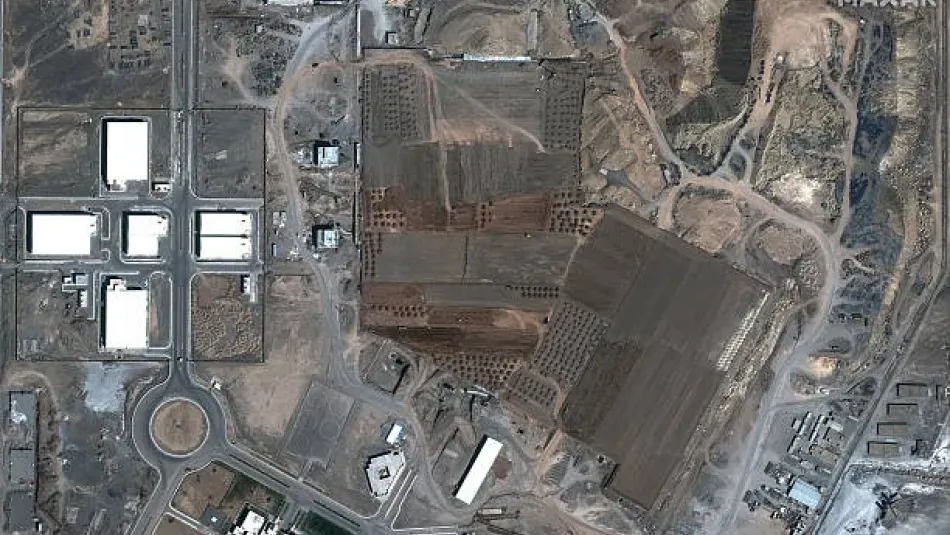
Mount Faz is strategically located approximately 220 kilometers south of Iran's capital, Tehran, and is only about two kilometers from the Natanz nuclear complex, which houses essential uranium enrichment facilities, according to Reuters. The Natanz complex has faced attacks during military operations that involved the United States and Israel, leading to the destruction of the above-ground enrichment facility. However, the International Atomic Energy Agency estimates that the underground facility has sustained significant damage.
According to the Institute for Science and International Security (ISIS), a U.S. research center specializing in nuclear nonproliferation issues, the facility being constructed within Mount Faz had not been a target of those earlier attacks. Iran began constructing the facility in 2020 following an explosion that Iranian authorities attributed to sabotage targeting the Natanz site, which resulted in extensive damage to its advanced centrifuge manufacturing program. In September of the same year, the then-head of Iran's Atomic Energy Organization, Ali Akbar Salehi, announced the country's intent to build a new facility within the mountain near Natanz, describing it as "more advanced, larger, and more comprehensive," aimed at manufacturing modern centrifuges.
The Director General of the International Atomic Energy Agency, Rafael Grossi, previously noted that Iran had announced its intention to relocate some of its most sensitive nuclear facilities to underground sites as part of a strategy to enhance their protection. Analysis of satellite images conducted by ISIS indicates that the facility includes pairs of tunnel entrances believed to lead to a single site located at least 100 meters below the mountain's surface. The report highlighted that the location is surrounded by stringent security measures, with robust fortifications at the tunnel entrances. Recent images have shown that Iranian authorities have partially filled in the eastern tunnel entrances to obstruct access by land vehicles, although they have not been completely sealed.
Despite Trump's threats, the Institute for Science and International Security asserts that the facility is not yet operational, and construction is ongoing. It remains unclear when it will become operational based solely on satellite images. The institute added that it is still uncertain whether Iran intends to use the site to establish a large facility for assembling centrifuges, particularly following the damage inflicted on its nuclear program. However, it does not rule out the possibility of repurposing the site in the future for a smaller facility that could support any nuclear program that Tehran might seek to rebuild.
As reported by daralmaref.com.