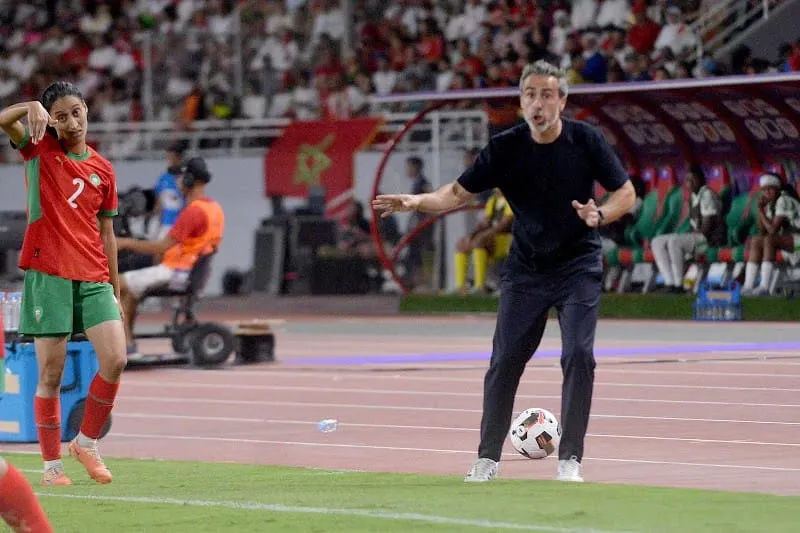

When the Royal Moroccan Football Federation appointed Spanish coach Jorge Vilda to lead the national women's team in October 2023, the choice was anything but ordinary. Vilda arrived in Morocco shortly after guiding Spain to victory in the Women's World Cup, a remarkable achievement that underscored his credentials. Prior to this, he had an extensive track record with Spanish national teams across various age categories, accumulating numerous continental and global titles and earning the distinction of being named the Best Women’s Football Coach by FIFA in 2018. Therefore, the expectations were clear: to leverage his wealth of experience and transition the "Atlas Lionesses" from mere competitors to champions.
However, nearly three years into Vilda's tenure, the results prompt a critical evaluation of his impact. Upon his arrival, Morocco was not merely a team in the midst of rebuilding; it had already established itself as a formidable force on the continent. Under the previous coach, Reynald Pedros, the Moroccan team reached the finals of the 2022 Africa Cup of Nations and advanced to the knockout stage of the 2023 World Cup, marking a historic milestone as the first Arab team to progress beyond the group stages in the Women's World Cup.
Building on Foundations: Vilda's Mixed Results
Vilda was tasked with building upon these achievements and transforming the team from a strong competitor into a continental champion. Unfortunately, the outcomes have not aligned with these aspirations. In the 2024 Africa Cup of Nations, hosted in Morocco in 2025, the team reached the finals for a second consecutive time but fell to Nigeria, losing three goals to two after previously leading two-nil. Subsequently, Morocco's journey in the 2026 edition ended in the semifinals against Cameroon via penalties, followed by a loss in the third-place match against Algeria, culminating in a fourth-place finish.
Thus, after three consecutive Africa Cup of Nations tournaments held in Morocco, the coveted continental title remains elusive for the "Atlas Lionesses": a runner-up finish in 2022 before Vilda's arrival, a second runner-up during his leadership, and a fourth-place finish in 2026. The focus now shifts not to the coach's ability to reach advanced stages, which he has demonstrated, but rather on his capability to achieve the breakthrough that Moroccans anticipated—transforming a strong presence into a championship title.
Vilda's Spanish Success: Where's the Impact in Morocco?
It is undeniable that Vilda possesses a robust record in Spanish women's football; his success is not limited to the senior team that he led to the 2023 World Cup but also includes significant achievements with youth teams, where he earned European titles and reached global finals. This extensive experience was one of the key reasons the Royal Moroccan Football Federation entrusted him with the national team. However, the paradox lies in the apparent lack of tangible impact from this experience on the Moroccan national team, particularly regarding the infusion of new talent. Morocco boasts a generation of players who have excelled at the Under-17 and Under-20 levels and participated in youth World Cup finals, yet the transition of these talents to the senior team remains limited. This raises a legitimate question about the training project and the link between youth teams and the senior squad.
It is essential not to place sole responsibility for this issue on Vilda, as it also involves national technical management led by Fethi Jamal, club dynamics, and the management of youth teams. However, the head coach of the senior team remains a crucial element in this project, especially given that his experience in Spain stemmed from a system that emphasizes discovering and nurturing talent before gradually integrating them into the senior team.
Another significant moment that cannot be overlooked when assessing Vilda's tenure is the qualification for the Paris 2024 Olympics, where the Moroccan team failed to overcome Zambia. After winning the first leg 2-1, their hopes collapsed in the return match, ending in a 2-0 defeat, thus extinguishing the dream of Olympic participation despite the team enjoying its best phase following the historic achievement in the 2023 World Cup.
This does not imply that every setback during Vilda's time can be attributed solely to him. Still, the accumulation of these events prompts questions regarding the genuine effectiveness of his experience, especially considering the high expectations set from day one, given Vilda's impressive background.
Interestingly, while Vilda's salary in Morocco reportedly exceeds what he earned in Spain—around 200,000 euros annually compared to approximately 170,000 euros as the Spanish national coach—the disparity between his remuneration and the titles achieved raises eyebrows. The issue is not merely about a coach receiving a high salary if his performance justifies it; rather, it concerns the relationship between what he earns and what he delivers. A coach with such a distinguished record cannot be evaluated solely by qualifying for the World Cup or reaching the Africa Cup of Nations semifinals, especially since Morocco had already achieved these milestones before his arrival.
Ultimately, it would be overly simplistic to reduce all the women's national team's challenges to Jorge Vilda's name, as this does not reflect the full picture. Morocco has invested significantly in women's football in recent years, hosting the Africa Cup of Nations three times in a row, developing youth teams, and regularly appearing in continental and global finals. However, these resources require a clear and sustainable project that defines the team's trajectory over the next five to ten years, rather than setting objectives for each tournament individually, placing the onus on the national technical management.
Vilda has succeeded in maintaining Morocco's status among Africa's elite, leading them to three consecutive Africa Cup of Nations semifinals and securing qualification for the 2027 World Cup. Therefore, labeling his experience a complete failure would be an exaggeration. Conversely, it is also challenging to deem the experience a success in the manner that the Moroccan public anticipated, as the team has yet to secure a continental title, and the emergence of a new generation capable of carrying the torch has not materialized as expected.
In conclusion, the question is not whether Vilda is a great coach; his tenure with Spain answers that unequivocally. The real question is whether Vilda was the right coach for the phase the Moroccan national team entered following Pedros. Morocco required not just a coach with a prestigious name but one who could add new value to a project that was already underway, transforming the "Atlas Lionesses" from runners-up and competitors for the title into champions, many of whom are nearing the end of their international careers. While Vilda has achieved glory with Spain and established a significant reputation in women's football, he has yet to replicate that success in Morocco. If he has surpassed his previous salary in Spain, the pressing question remains: when will he also exceed his achievements there with titles and accomplishments alongside the Moroccan Football Federation and its technical management?
As reported by hesport.com.