
Understanding the EU-Morocco Dynamic
Welcome to Bruselandia, a metaphorical blue carpet ecosystem where the European Union (EU) advocates for human rights while simultaneously signing checks with the other hand. It is unfortunate but true; the relationship that epitomizes the duplicity and realpolitik of the EU capital is its strategic alliance with Morocco. This partnership, while rooted in the necessity of border management, has evolved into a complex interdependence that has allowed Morocco to equal or even outpace the initial dominance of the EU. The diagnosis is clear: the EU has granted too much power to Rabat. Far from being a mere southern neighbor that complies with Brussels regulations or benefits from trade ties, Morocco has transformed its role into that of a strategic actor within the EU framework.
The border crisis in Ceuta serves as a prime example of this dynamic, extending far beyond Spain itself. To understand how the Moroccan Kingdom has matched and even surpassed a Europe that is increasingly fearful of immigration, one must consider several key factors that highlight Morocco's power in Brussels. Geopolitically speaking, geography is an essential prisoner of its own constraints, as Tim Marshall might assert. Located a mere 14 kilometers from the European continent across the Strait of Gibraltar, Morocco serves as a vital bridge connecting Europe, Africa, the Middle East, and the Atlantic world. As noted by the Policy Center for the New South, Rabat has established a winning strategy as a 'connector state' in an increasingly fragmented global landscape.
Morocco's Strategic Maneuvering in Brussels
While many regional countries have descended into institutional collapse, civil wars, or military interventions, the regime under King Mohammed VI has demonstrated remarkable resilience. This institutional strength is Morocco's greatest asset. Europe looks south and sees a Sahel engulfed in flames, a fragmented Libya, and rising Russian and Chinese influence throughout Africa. In this context, Morocco presents itself as the only apparent oasis of stability, a perception that may be misleading to those unwilling to see the underlying issues. The Kingdom possesses territory, state control, and the key to access Europe, along with the audacity to understand that Europe needs them more than European leaders would like to admit.
Morocco has transitioned from being a mere recipient of aid to becoming a 'co-producer of Euro-Mediterranean security.' Its contributions to Brussels are categorized into three pivotal pillars essential for the peace of the average European voter. The first is immigration; Morocco has evolved from a nation of emigration to one of transit and destination. It acts as the gendarme of the western Mediterranean and Atlantic towards the Canary Islands, leveraging this role to enhance its negotiating power. Intelligence and counter-terrorism also play a significant role in this relationship. Following the Casablanca bombings in 2003, Morocco has developed one of Africa's most sophisticated security architectures, providing crucial intelligence to dismantle plots and prevent jihadist attacks on European soil, notably in France, Belgium, and Spain.
Brussels also seeks to disentangle itself from distant and problematic supply chains, prompting a pivot to the south in its green transition through nearshoring—relocating production, manufacturing, or services to a nearby country with shared interests. Advocates of this alliance argue that Morocco offers industrial connectivity, immense potential in renewable energies and green hydrogen, and a safer environment for European investments. However, the Moroccan regime lacks significant fossil energy resources and suffers from chronic socioeconomic issues, making its desires from Europe quite evident, as detailed by the European Council on Foreign Relations (ECFR): financial support, favorable trade agreements, and above all, unwavering diplomatic backing.
The absolute red line of Morocco's foreign policy is Western Sahara. It demands that Europe disregard UN resolutions concerning referendums about the future of a territory still administratively overseen by Spain, and openly recognize Moroccan sovereignty over the land, a move that Spanish Prime Minister Pedro Sánchez undertook in 2022. Additionally, Rabat expects silence from Brussels regarding its human rights record and the repression of civic protests, which arise during all negotiations. In 2016, the Moroccan king made it clear that he would not tolerate interference in domestic policies, threatening to diversify alliances towards the Gulf Cooperation Council, China, or Russia if Europe became overly demanding regarding democracy.
The collapse of the 1991 ceasefire between Morocco and the Polisario Front resurrects a conflict for which Spain bears significant historical responsibility. The benefits for Morocco are substantial; for instance, since 2021, the European Neighbourhood Instrument (ENI) has mobilized over 8.1 billion euros for Morocco, including 500 million for migration control and 5 billion for economic and trade development, as part of the Global Gateway initiative, an alternative to China's Belt and Road Initiative. The European Investment Bank (EIB) also plans to channel over 700 million euros into the country this year, with investments such as 365 million for transportation modernization, making Morocco the largest beneficiary of EU aid in the Mediterranean.
This is complemented by fishing and agricultural agreements, which have historically been contentious in European courts due to their inclusion of waters from Western Sahara. However, the greatest advantage is strategic: impunity. As highlighted by Carnegie Europe, the EU has attempted to 'externalize' border control over the last decade by approaching autocratic governments. Morocco boasts an unwritten pact whereby, in exchange for curtailing immigration and providing intelligence, Europe turns a blind eye to the growing authoritarian tendencies of the state, similar to what has been happening with Turkey for years.
When young Moroccans protest against their living conditions and are met with severe repression, European institutions, at best, issue lukewarm statements. Simultaneously, Brussels accelerates plans for a 'New Pact for the Mediterranean,' granting Morocco privileged partner status. To grasp the extent of Europe's entrapment, one need only examine recent border crises, which serve as perfect case studies of Rabat's power. As political essayist Richard Youngs notes in Carnegie, Europe has systematically failed to learn lessons from events such as Ceuta. The pattern remains consistent: Morocco first relaxes border controls or encourages thousands of desperate individuals to surge towards the fence or the sea. It is unclear who sent the initial message or who ordered what, but evidence suggests that Morocco did little to stem the tide. Sánchez has stated that the gendarmerie 'allowed' people to cross for ten hours.
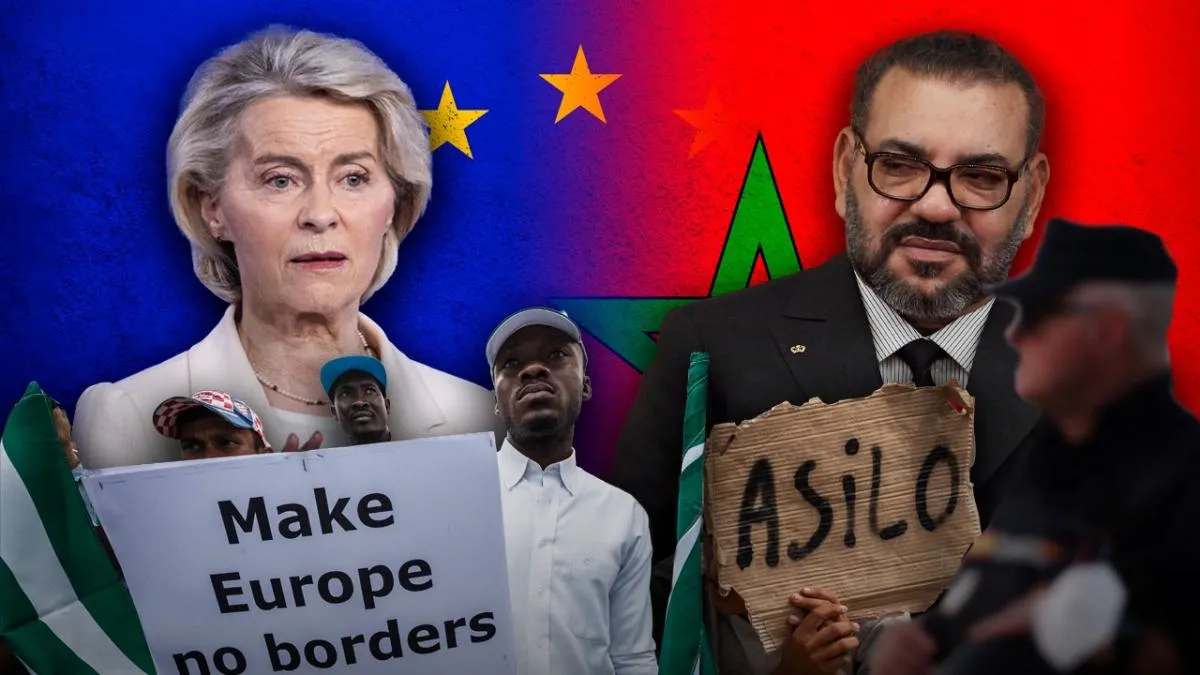
Morocco's objective in such actions is typically to punish European countries for political decisions that displease Rabat, such as hosting Sahrawi independence leaders or uncomfortable resolutions from the European Parliament, reminding Brussels who holds the 'red button' of the border. Subsequently, Morocco presents itself as the 'necessary' and indispensable partner to resolve the crisis it has created. The European reaction? Dependency and weakness. Instead of reevaluating this failed policy, the Commission, led by Ursula von der Leyen, reacts by pulling out the checkbook and offering more funds to Rabat. We saw this happen in August when Madrid complained about a lack of solidarity from other member states and condemned the extreme right's instrumentalization of the issue, ultimately leading to the EU shelling out euros for border controls and fences, effectively rewarding the tactic of blackmail.
In this ecosystem, schemes like Moroccogate flourish. Morocco wields such influence that it has managed to evade negative labels, with more focus on Qatargate, a lesser branch of the supposed bribery and intelligence pressure scandal unveiled four years ago. Over 600,000 euros in cash, computers, and mobile phones were seized, with arrests made for corruption, money laundering, and organized crime—all within the European Parliament and Brussels think tanks. The case is currently under active judicial investigation, but no trial date has been set.
This is the capital of lobbying, and Morocco has quickly learned that pressure must also be applied in the hallways. The country's strategy has involved weaving influence networks to neutralize any critical resolutions regarding Western Sahara, the exploitation of minors during the migration crisis (such as the European resolution of June 2021 that deeply angered Rabat), or human rights violations against Moroccan journalists and activists—issues repeatedly reported by Sahrawi representatives in the EU capital. Morocco buys goodwill and invests in covert diplomacy to ensure that European Parliament reports are more palatable and that cooperation budgets and agricultural agreements do not suffer cuts. The true tragedy is that the entire European system, encompassing both center-right and progressive center-left factions in Spain, France, and the rest of the EU, ultimately succumbs to this dynamic. They preach 'democratic security' in their speeches while practicing illiberal foreign policy. This is true for the Gulf monarchies, Israel, China, and more.
Now, 30 years after the first major agreements, the EU-Morocco relationship stands under intense geopolitical pressure. Mohammed VI understands that, despite economically relying on exports to Europe, he is the one dictating the political moves on this board. Morocco has managed to have Europe finance the modernization of its state, turn a blind eye to Western Sahara, remain silent on internal authoritarianism, and, furthermore, thank it for doing the dirty work regarding immigration. Outsourcing border control to non-democratic regimes carries a high political cost, a warning to those navigating the new Migration and Asylum Pact, which advocates for similar arrangements with other dubious countries.
Morocco serves as a mirror reflecting the EU's greatest inconsistencies. As long as the fear of immigration dictates the EU's foreign policy, the price that Rabat demands will continue to be paid, regardless of the moral outrage expressed within the European Parliament.
As reported by huffingtonpost.es.