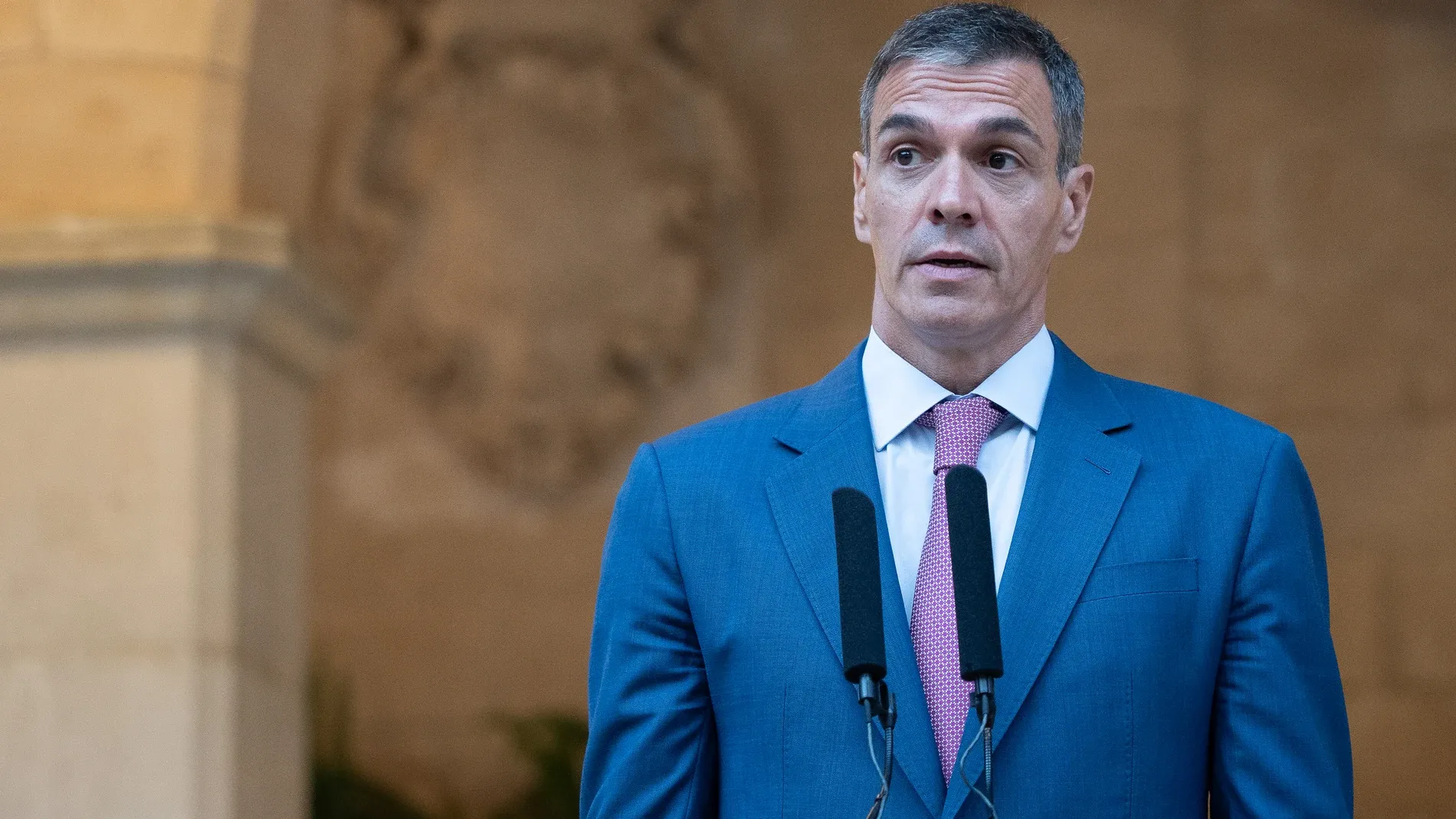

The ongoing campaign concerning the sovereignty of Ceuta and Melilla is not merely a trivial matter; it lies at the very heart of the issue from the outset. It is hard to imagine that Pedro Sánchez has spent his recent days at La Mareta merely trying to cultivate a public image. After all, the trend of recommending unread books and curated playlists has grown stale, and Sánchez is known for his desire to remain on the cutting edge of public perception. It seems fitting for him, as his approach to cultivating an appealing persona aligns with his penchant for being perceived as the most stylish and charismatic leader. Despite the setbacks he has faced, including the Pope overshadowing his 'six-seven' moment, he still has the option of utilizing the popular trend of 'mewing'—a facial gesture that emphasizes jawline definition and confidence.
However, he will require more than just a polished image to overcome the inertia, mismanagement, and discredit that have plagued his administration during the most severe crisis our country has faced since the events of February 23, 1981. In one instance, he did manage to articulate a crucial point: acknowledging the entry of a civilian equivalent to an Army Corps into Ceuta as an attack on territorial integrity and a violation of our sovereignty. Yet, what is perplexing is his failure to take any substantive action in response to such a grave situation. If one recognizes a hybrid attack on national borders, the least one would expect is to identify the source and confront it, which he has failed to do on both counts.
Meanwhile, the Moroccan authorities have relentlessly propagated their own fabricated narrative since day one, delivering a series of calculated blows to Spain and its government, confident that their actions would face no repercussions. The controversy surrounding whether they were aware of the situation or acted to address it is absurd. They have utilized social media and state-controlled Moroccan media not only to impose their version of events but also to conduct an aggressive campaign asserting the Moroccan identity of Ceuta and Melilla. While they have claimed these territories since their inception as a nation in 1956, the intensity and audacity with which they have pursued this claim have escalated dramatically, coinciding with the tacit invasion of civilians. This includes influencers riding jet skis around so-called 'Moroccan' rocks and social media accounts asserting that the Umayyad dominance over the peninsula was, in fact, Moroccan. Such assertions might be dismissed as nonsense, but they serve as a rallying point for public sentiment.
This situation could have remained a mere anecdote of political manipulation if not for the statements made by members of the Moroccan government. For instance, the Moroccan Minister of Justice has made remarks that have gone unanswered by our government. Abdellatif Ouahbi recently gave an interview to Al Arabiya, making bold claims, even as the Moroccan narrative is essentially an attempt to cultivate their own aura. He stated, "Of course, we are following the matter as a whole," when asked about videos where individuals crossing the border claimed to have received a blind eye from Morocco. His admission of inaction implies a troubling acknowledgment of negligence. He further justified their non-intervention by stating, "If we had engaged in direct confrontation, it could have resulted in many casualties. That’s why we managed the crisis with intelligence, calm, and responsibility."
Ouahbi’s statements reflect a level of audacity that surpasses anything seen from the Sánchez government, asserting that some youths expressed a desire to enter Ceuta because, in their view, it is Moroccan territory. He went on to argue that he could not stop them from holding such beliefs, framing it as a constitutional right to move freely within Moroccan territory. This level of insolence from a supposed ally is unprecedented.
The campaign regarding the sovereignty of these Spanish cities is not trivial; it is fundamental. I would argue that this issue has been at the core of the debate from the very beginning. This invasion represents a gesture of hybrid warfare, and the government's purported humanitarian response is entirely inappropriate. The Moroccan minister goes further to dismiss the notion that a police solution will suffice, stating, "The only lasting solution requires reaching an agreement with Spain, making definitive decisions, and establishing permanent procedures." He is indeed discussing negotiations concerning Spanish sovereignty, yet no response has been forthcoming from the Spanish government.
Moreover, we must examine the official website of Defense Atlas, a think tank that operates under what is known in intelligence circles as 'informational hybrid warfare,' which serves as a tool aligned with Morocco's defense agenda, pressuring Algeria and justifying the actions of the Alaouite Kingdom before external allies like Spain or the United States. Recently, they released a message stating, "Urgent. Ceuta. Military estimates and security analyses indicate that the Spanish army will not be able to halt any Moroccan military movement toward the occupied cities. The Moroccan Army is capable of deploying rapidly within Ceuta in a surprising, swift, and overwhelming manner, utilizing advanced capabilities in electronic warfare and effective engagement tactics against hostile forces, along with field plans for civilian protection."
This threat is compounded by Defense Atlas releasing a video with the slogan, "There are no Moroccans on the coast. Are you sure?" The message, written in Spanish, is accompanied by images of submarines and divers landing on territory, constituting a direct threat—a clear example of psychological hybrid warfare. Yet, it seems no one will respond to this provocation.
It appears that inaction is the order of the day; these incidents happen without consequence. We are left to deal with what should be a pressing concern under the oversight of the most ineffective government in our democratic history. The troubling reality is that we are compelled to confront these challenges precisely because of this ineptitude.
As reported by larazon.es.