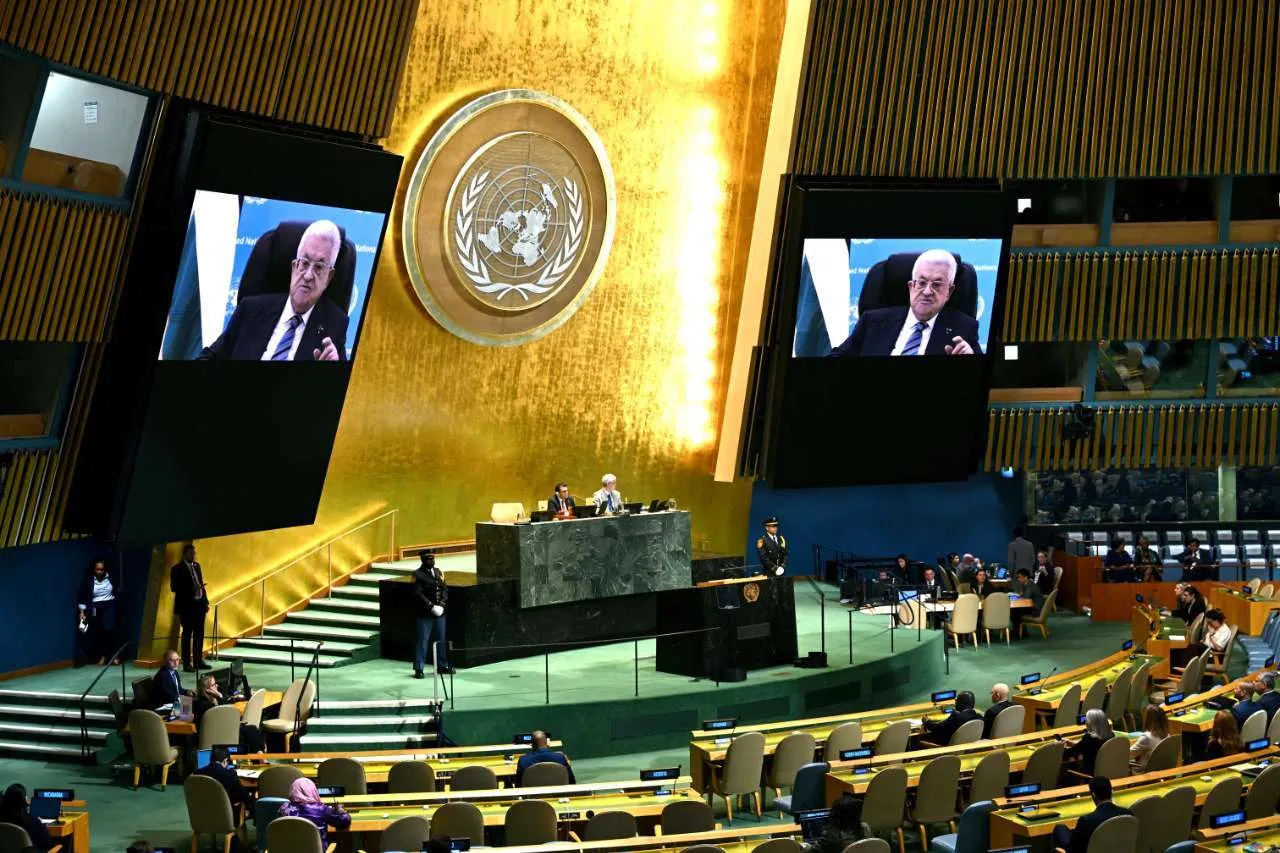

The recent actions of the U.S. administration have raised significant concerns regarding its role as host of the United Nations, particularly following the decision to deny entry to Palestinian President Mahmoud Abbas for the UN General Assembly. Instead of addressing the pressing issues at hand, Abbas was forced to deliver his speech via video link, highlighting the growing chasm between the U.S. and the Palestinian leadership. This incident underscores a broader trend in U.S. foreign policy, which contrasts sharply with the diplomatic approaches adopted by many West Asian countries.
While the foreign policies of the U.S., EU Commission, and certain EU member states often lean towards confrontation, the nations of West Asia, with Israel as the notable exception, have predominantly sought dialogue as a means to foster peace. Israel is widely perceived by its regional neighbors as a significant threat to stability between the eastern Mediterranean and the Persian Gulf. The Abraham Accords, signed during the first term of U.S. President Donald Trump by Bahrain, Morocco, and the United Arab Emirates, have yet to yield tangible benefits for these nations. While the presence of Israeli military forces and companies has been heralded in the West as a harbinger of "peace and prosperity," the reality on the ground tells a different story, marked by conflict and destruction.
Bahrain is currently in ruins, and the UAE has also faced significant devastation. Morocco is preparing to host an Israeli embassy and establish a military base, all while tensions with neighboring Algeria escalate. The ceasefire between Morocco and Western Sahara is increasingly precarious, as Israel supports Morocco's annexation efforts, contradicting the aspirations for self-determination by Algeria and the Frente Polisario, the Sahrawi liberation movement. Morocco's proposal to grant "autonomy" to the Sahrawi people is backed by the United Nations, which had previously pledged a referendum for the Sahrawis to decide their future, a promise that remains unfulfilled as the UN mission, MINURSO, has not yet produced any results.
This situation exemplifies how the international community can delay the resolution of legitimate claims by smaller nations. The land of Palestinians, Syrians, and Lebanese has been forcibly divided since the Sykes-Picot Agreement of 1916, followed by the Balfour Declaration in 1917, which laid the groundwork for British mandate Palestine. The UN's 1947 resolution to establish a Jewish state alongside a Palestinian state was undermined by the violent establishment of Israel in 1948, resulting in the displacement of over 700,000 Palestinians to neighboring countries. Today, Palestinians continue to face violence and eviction from their homes, as they await the realization of their right to return and an end to the illegal occupation.
The historical connections that bind the countries from the eastern Mediterranean to the Persian Gulf and beyond, including to China, have deep roots. The Silk Road, which dates back to at least 300 BC, facilitated trade and cultural exchanges between these regions. However, it also served as a battleground for emerging religions and societal structures, leading to the plundering of wealth and the capture of individuals.
As European colonial expansion increased around 1500 and continued through the 18th and 19th centuries, Western influence grew in Central Asia, often dismantling local and regional political structures in nations like Afghanistan and India. The discovery of oil at the turn of the 20th century further intensified Western interest in the region, leading to the imposition of spheres of influence and the fracturing of societal structures based on ethnic and religious lines.
The military establishment of the state of Israel in 1948 was supported by Western powers, which provided financial, political, and military resources. In the wake of World War II, Israel received assistance similar to that given to apartheid South Africa, including nuclear technology. As the recent UN General Assembly convened, Israel took delivery of a new German-made submarine, the INS Drakon, which is capable of carrying nuclear weapons, although this remains officially unconfirmed. The submarine represents a significant enhancement of Israel's military capabilities, allowing for operations further afield than ever before, including in Iranian waters.
The geopolitical landscape shifted dramatically in 2025 when Israel and the U.S. launched an unprovoked attack on Iran, despite ongoing negotiations between the U.S. and Iran, which were opposed by Israel. The Iranian government, which has maintained a civilian nuclear program and adhered to the Non-Proliferation Treaty, faced severe repercussions as the U.S. imposed a naval blockade, leading to international economic consequences.
As tensions continue to escalate, Iran anticipates further military aggression from Israel and the U.S., particularly following the massive delivery of munitions to Israel, reported to be around 60,000 bombs. Germany, as the second largest arms supplier to Israel after the U.S., has also approved the transfer of military goods worth over 735 million euros, further complicating the situation.
Current Israeli Prime Minister Benjamin Netanyahu has acknowledged that Israel is engaged in conflicts on multiple fronts, including Gaza, the West Bank, Lebanon, Syria, Iraq, Yemen, and Iran. This reality underscores the authentic geopolitical risks posed by Israel, as it continues to operate under the aegis of Western support, which has historically maintained extensive relationships in the region.
The ramifications of these conflicts extend far beyond the region itself. The Iranian government, under U.S. sanctions since 1979, has exhibited restraint in its response to foreign interference. Nevertheless, it has consistently supported like-minded organizations across West Asia, striving for liberation from occupation and external control. The West, with its superior military might and deep-rooted ties in the region, continues to leverage a range of strategies, from military intervention to the utilization of soft power through NGOs and foundations that often pursue Western interests rather than those of the nations they claim to assist.
As reported by zlv.lu.