
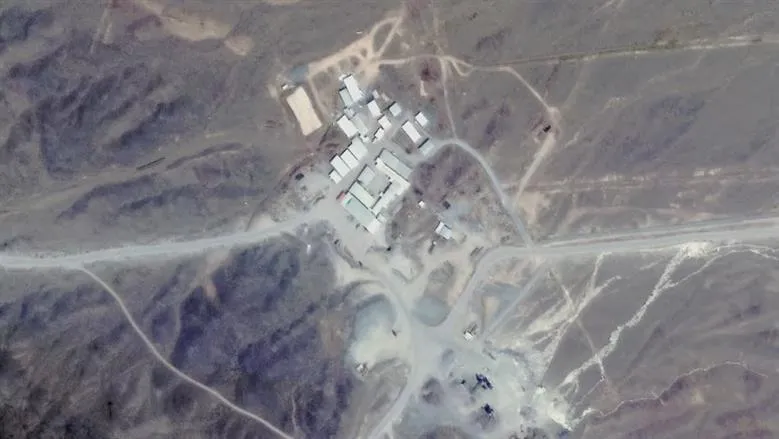

Increased Construction Activity at Iran's Suspected Nuclear Site
Analysts have observed a significant uptick in construction activities within a suspected Iranian nuclear site buried deep within a granite mountain, coinciding with the ongoing conflict between the United States and Iran. As Washington searches for means to target Iran's fortified underground facilities, recent satellite imagery analyses conducted by the Center for Strategic and International Studies (CSIS), exclusively reviewed by CNN, reveal a marked rise in construction activity at the "Axe Mountain" site this year, following a six-year review of satellite images.
This clandestine site is located near the Natanz nuclear facility, approximately 225 kilometers south of Tehran, and has garnered the attention of intelligence agencies as a potential location where Iran might shield parts of its nuclear program in the future. Analysts at CSIS speculate that the facility under the mountain could serve one of three purposes related to Iran's nuclear ambitions: assembling centrifuges, enriching uranium, or providing a secure haven for other nuclear-related activities, such as uranium conversion to metal.
Changing Nature of Activities and Military Challenges
Recent satellite images indicate a shift in the nature of operations at Axe Mountain, moving from intensive excavation to activities believed to be linked to internal construction, while external reinforcement efforts continue. Analysts have also detected increasing activity on the roadways leading to the site, alongside efforts to raise and reinforce tunnel entrances, pave internal roads, and stabilize access areas, all while excavated earth is removed in significant quantities.
According to the CSIS analysis, the level of activity observed on the roads leading to the site in 2026 was the highest recorded to date. Nevertheless, the analysts concluded that the ongoing construction suggests that the facility may not yet be ready for uranium enrichment operations, should that be its ultimate purpose.
Axe Mountain presents a formidable military challenge due to its location beneath thick granite layers, rendering it a target that is difficult to penetrate even with the most powerful American bunker-busting bombs. This site is not the only one raising concerns in Washington about Iran's deeply buried nuclear installations. The U.S. military has previously grappled with difficulties in targeting similar facilities during past strikes against Iran's nuclear program, including operations conducted in June 2025 under the codename "Midnight Hammer." Despite the destruction of several key installations, a senior American general informed Congress that the underground Isfahan facility had not been fully targeted, as the Pentagon determined that the available penetration bombs were insufficient for the task.
Amid these challenges, the United States is actively developing military capabilities that enable it to target facilities buried at even greater depths. Just four days before the U.S. commenced its "Epic Fury" operation, a program director at the Pentagon's Defense Threat Reduction Agency justified an emergency contract worth $1.2 million for work at an underground test facility at the White Sands Missile Range in New Mexico. According to a document published in the federal contracting database, the purpose of the work was to prepare the facility for live-fire testing to verify covert capabilities in response to "rapidly emerging threats." The document specified that the preparations must be completed within two to three weeks due to a "time-sensitive national security directive." Contract records indicate that Pate Construction submitted its bid on February 17 and was awarded the contract the following day. Satellite images reviewed by CNN indicated that excavation work commenced at the site between February 16 and 18, continuing until mid-March, resulting in significant amounts of excavated earth.
The test facility is situated within a granite-carved area and is managed by the Defense Threat Reduction Agency and U.S. Strategic Command. However, CNN has stated that it could not independently confirm the execution of the test or ascertain the actual purpose of the excavation work, and neither the Pentagon nor Pate Construction responded to requests for comments.
According to three informed sources who spoke to CNN, the test plans were linked to the ongoing conflict with Iran and the necessity to develop a means of targeting facilities buried at greater depths. One source indicated that the test was likely meant to simulate the use of American weapons against fortified Iranian nuclear installations. Concurrently, the U.S. Department of Defense retains operational plans to strike the Axe Mountain site, which was part of a target package reviewed during the summer when President Donald Trump threatened to escalate the conflict with Iran. A source familiar with the plans disclosed that options included deploying some of the most powerful bombs in the American arsenal, although the ability of these munitions to penetrate the ground deeply enough to destroy facilities where Iran might have relocated its nuclear equipment remains unclear. The Department of Defense continues to explore new options to address the challenge of deeply buried facilities, with officials recently conducting an intensive planning session to discuss how to execute decisive strikes against these sites.
In parallel, the U.S. military is working on developing a next-generation bunker-buster bomb to replace the current weapon, capable of reaching targets buried at greater depths. A contract for the prototype development of the new weapon was awarded in September 2025, while the U.S. Air Force requested defense contractors to submit proposals for the weapon's development in June. The developments at Axe Mountain, combined with the observed testing activities at White Sands and the advancement of new weaponry, suggest that Iran's deeply buried nuclear facilities pose an increasingly daunting challenge to U.S. military capabilities.
As reported by elwatannews.com.
