
The Harrowing Journey of Omar: A Tale of Displacement and Desperation
A 19-year-old boy, whom we will refer to as Omar, should have been featured in the pages of this newspaper with his name and image, recounting his story as an immigrant. Recently, we interviewed and photographed him at the beach of El Trampolín, where he had set up a tent resembling an igloo amidst a shantytown that stretched over a kilometer long. Omar’s unique profession and the significant role he played in Morocco drew our attention. He explained that he had decided to swim to Ceuta on July 28, just two days before a massive influx of migrants, stating, "There are no more opportunities for me to grow there."
However, we are concealing his identity, as Omar is one of the individuals displaced from El Trampolín last weekend and has since returned to Morocco. He is among the 1,823 immigrants, as reported by Minister Ángel Víctor Torres, who opted to return voluntarily during the dismantling of the camp over the weekend.
Yet, Omar refutes the idea that his return to Morocco was a voluntary choice. On October 8, just four days after the eviction, he reached out to this newspaper seeking assistance. "I was sent back to Morocco. I returned on Sunday. I've been looking for your number to contact you. Is there any possibility for me to come back? I beg you. Please help me. I will never forget this favor you do for me. I will be grateful for life," he pleaded.
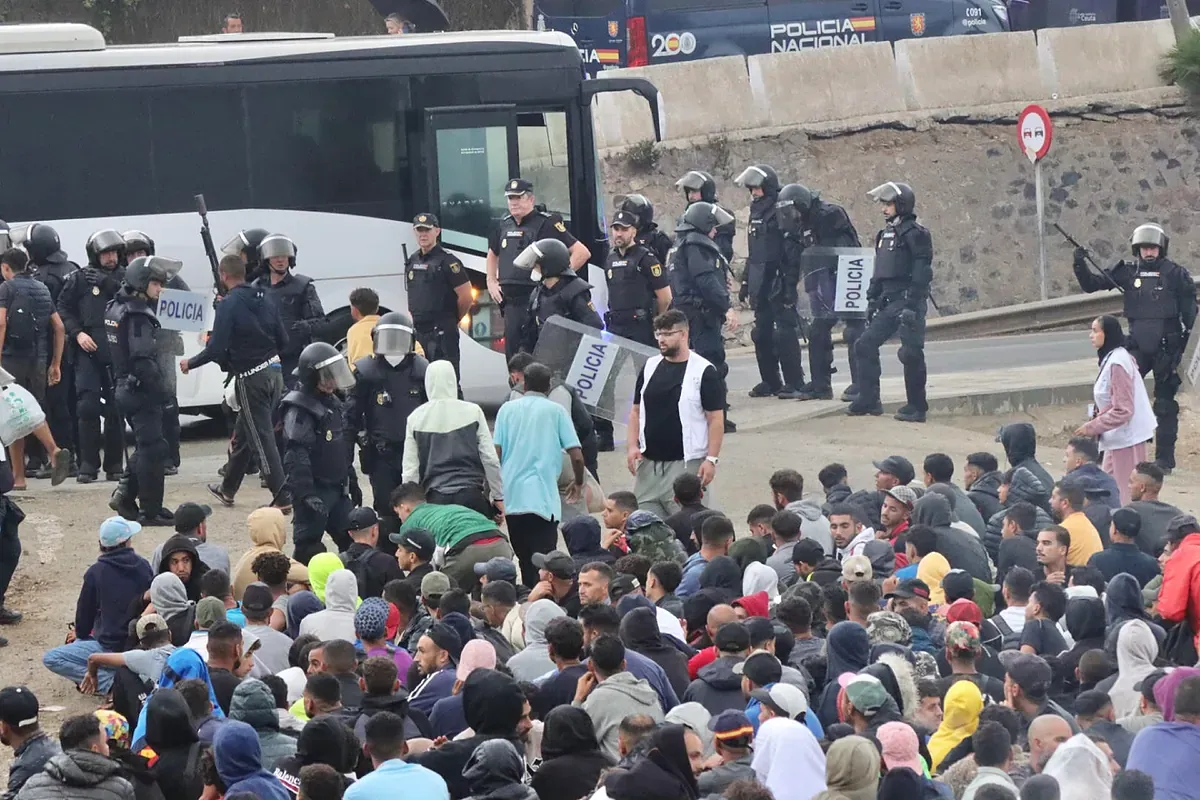
In his account, Omar explained, “On Sunday morning, soldiers and security agents surrounded us.” Speaking in Dariya, the Moroccan dialect of Arabic, he detailed how they were told they would be taken for processing but instead were put on buses heading directly to the border. “They told us that Morocco had reached an agreement with Spain to return all migrants, and that’s how the dream ended.”
When asked who informed them about the supposed agreement with Morocco, Omar responded that it was the Spanish agents themselves who claimed they had come to such an arrangement.
According to Omar's testimony, they were evacuated from El Trampolín and transported on buses that were supposed to take them to the Temporary Reception Center for Foreigners (CATE) for identification and the opportunity to apply for asylum with the assistance of a lawyer and translator if needed. Instead, he claims, the buses took them straight to the border. There, the Moroccan military awaited them, transporting them to cities far from their homes. Omar, originally from Casablanca, ended up 440 kilometers away in Tinghir. By the following Friday, he found himself just 38 kilometers from his hometown.
Shared Experiences of Eviction from El Trampolín
This newspaper has gathered testimonies from two other Moroccan immigrants who were also evicted from El Trampolín that weekend, both denying they willingly returned to Morocco and sharing similar accounts. Another 19-year-old stated, “The police took me and expelled me forcefully. They say, ‘We are taking you to the camp.’ You get in the vehicle with them, and they drive you straight to customs. They push you through as if you have no dignity, like you're an animal. And then you’re handed over to the Moroccan army, who then transport you to a city far from yours.” This young man, also from Casablanca, ended up in Agadir, which is 855 kilometers from the border and 473 kilometers from his home.
Another immigrant, Ibrahim, 29, originally from Tangier, ended up in Kelaa des Sraghna, 623 kilometers south of the border. He described his departure from the Spanish autonomous city: “They woke us up in the morning and brought four translators. We were told not to be afraid because we were being taken to the camps. Then they brought buses, and we boarded them. They took us to customs and made us disembark in groups of five. Inside customs, we met people wearing green vests who translated for us. They informed us that the decision had been made for us to return to Morocco as we were. Afterward, they processed us and loaded us onto a bus bound for El Kelaa des Sraghna.”
On the same day that Omar contacted EL MUNDO for help, Minister Ángel Víctor Torres addressed the press following a meeting of the Ceuta Situation Committee. After updating the figures on the mass entry—reporting that 11,026 had returned, with 10,513 doing so voluntarily—he was questioned by a journalist regarding allegations from some migrants that the information provided by the police during the El Trampolín eviction was unclear, leading them to unintentionally return to Morocco.
Torres responded, “We are not deceiving anyone because we have clearly stated that the majority of immigrants who crossed into Ceuta from Morocco on July 30 and 31 are Moroccans who do not have the right to international protection. Once transported by bus, they only have two options: if they get off the bus, they go to CATE where they are informed about the process. Many choose to return, as they do not want to have a police record.”
This newspaper previously reported that on Sunday evening, the first day of the eviction, several Ceuta lawyers were urgently mobilized at the request of the police to assist in the processing of 140 immigrants expected to arrive on three buses. To their astonishment, the buses arrived empty, as all the immigrants either escaped or voluntarily returned to Morocco.
“On September 24, I stated that we expected to evacuate that beach before October 15. We achieved that goal even ahead of the timeline we set,” boasted Ángel Víctor Torres after the eviction.
As reported by elmundo.es.