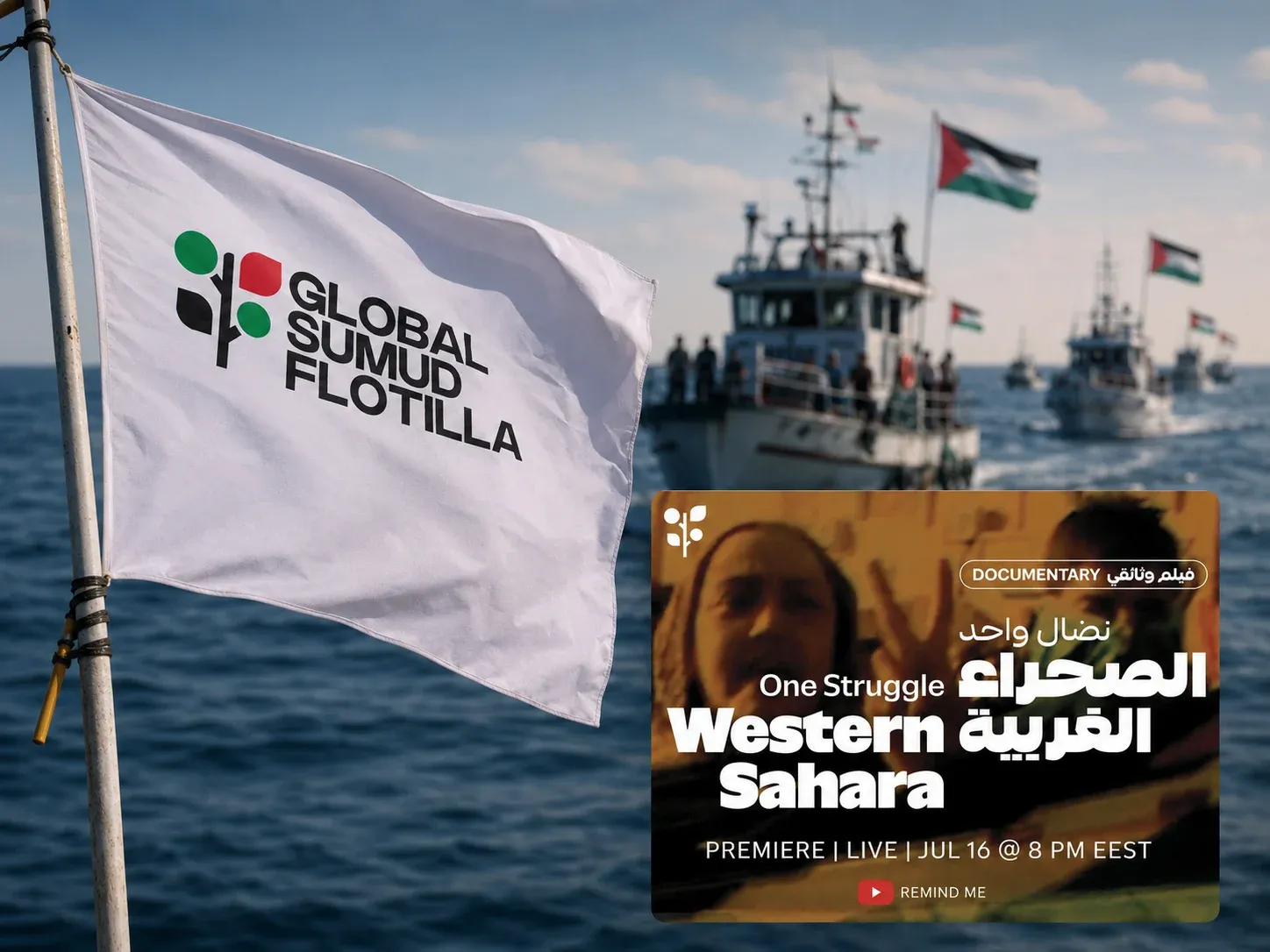

On July 14, the Global Sumud Flotilla declared its intent to release a 14-minute documentary titled "One Struggle: Western Sahara" on July 16. This extensive maritime coalition, which has dedicated much of the past year to sailing across the Mediterranean in an effort to showcase solidarity with Palestine, faced numerous challenges, including interceptions, detentions, and deportations. Ultimately, however, the film was not published, succumbing to significant pressure from Moroccan authorities.
In this documentary, the flotilla openly endorsed the Polisario Front, labeling it as a "Sahrawi liberation movement." They made the erroneous claim that the International Court of Justice (ICJ) rejected Moroccan sovereignty over Western Sahara and declared the film as the first entry in a series that would investigate the connections between various resistance and liberation movements globally. This move was not an unmasking of hidden motives but rather a deliberate unveiling of their ideological stance, clearly visible for all to comprehend.
For those who have observed the Sumud Flotilla with skepticism, questioning whether its humanitarian mission was genuinely altruistic, the documentary served as a confirmation of their doubts. It marked a pivotal acknowledgment that their ambitions reached far beyond the humanitarian plight of Gaza, delving into the contentious ideological battleground of Cold War-era liberation movements. In this narrative, every conflict is treated as analogous, every state is portrayed as a colonizer, and every armed separatist faction is depicted as a legitimate resistance movement worthy of unqualified support.
The flotilla's attempt to equate the struggles of Palestine and Western Sahara, drawing parallels between Israel's military occupation of Gaza and Morocco's governance over its southern provinces, is not only historically inaccurate but also politically offensive. The Polisario Front should not be conflated with Hamas, nor should Morocco be equated with Israel.
The situation surrounding Western Sahara is a territorial dispute that is addressed through a UN-led political framework and resolved via Security Council resolutions, with the most recent being Resolution 2797, which supports the negotiated political solution that Morocco has proposed through its autonomy plan. Reducing this complex scenario to a mere slogan – "one struggle" – exemplifies the most superficial and intellectually disingenuous form of global activism, one that favors simplistic solidarity over the rigorous understanding of the conflicts it purports to care about.
The deeper deception lies in the fact that, despite its grandiose displays – including over 100 boats, celebrity participants, and live broadcasts from Barcelona – the Sumud Flotilla has yet to deliver a single kilogram of aid to Gaza. The missions in 2025 and 2026 faced significant challenges, including interceptions by Israeli forces that resulted in the detention of hundreds of activists. The flotilla's activities have thus far produced stories of confrontation rather than tangible assistance for the people of Gaza, who remain as besieged and impoverished as ever.
In stark contrast, Morocco, under the directives of King Mohammed VI, has actively provided humanitarian aid to Gaza, delivering nearly 280 tonnes of medical and food supplies in 2025 alone, including significant contributions in July and August. This aid was transported through a unique overland corridor that Morocco successfully negotiated, ensuring that vital resources reached Palestinian civilians. Foreign Minister Nasser Bourita emphasized this commitment to "concrete solutions" that materially benefit the population, a stark departure from the performative nature of the flotilla's initiatives.
Moreover, Morocco's contributions extend beyond mere aid deliveries. As the first Arab country to deploy troops for the International Stabilization Force (ISF), Morocco has taken proactive steps to support peace and stability in the region, including plans for a military field hospital and a deradicalization program. This engagement is the result of a long legacy of diplomatic mediation, dating back to King Hassan II's discreet negotiations with both Arab and Israeli leaders long before the Oslo Accords were conceived. Unlike the flotilla, Morocco engages directly with the Palestinian people rather than allowing their representation to be manipulated by external forces.
The Bayt Mal Al-Quds Agency (BMAQ) operates various initiatives, such as building schools, rehabilitating hospitals, and supporting scholarships for Palestinian students in East Jerusalem. Morocco's participation in the ISF is formalized through an agreement with the Peace Council for Gaza, emphasizing a commitment to stability and humanitarian support that does not seek the spotlight of social media.
By aligning itself with the Polisario Front's separatist agenda, the Sumud Flotilla has inadvertently unveiled its underlying ideological framework, which echoes a 1970s liberation theology that divides the world into colonizers and the colonized. The so-called "Sahrawi Arab Democratic Republic (SADR)"—a state lacking territory, governance, and a viable population—has long appropriated symbols from the Palestinian cause, attempting to leverage the moral authority of their struggle in an entirely different geopolitical context. This strategic borrowing aims to frame Morocco, a nation with a rich historical legacy, as a colonial entity.
As the U.S. Congress considers bills to designate the Polisario Front as a terrorist organization, citing its links to Iran and Hezbollah, it becomes evident that the ideological foundations of the flotilla's narrative are deeply flawed. The doctrine of self-determination posited by the flotilla, which suggests that it supersedes sovereignty and historical realities, is not a sound principle but a destructive ideology that risks fragmenting states into countless micro-nations based on ethnic or ideological identities.
Ultimately, the world operates on a principle of consolidation rather than fragmentation. The resolution of the Western Sahara issue hinges on pragmatic negotiations rather than the performative activism of the flotilla. Morocco's Justice and Development Party (PJD), which holds sympathies for the Palestinian cause, condemned the documentary as a serious misstep that jeopardizes the flotilla's credibility among Moroccans and undermines its original mission of addressing Israel's blockade of Gaza.
In summary, the Sumud Flotilla's misguided linkage of its activism to the Polisario Front has revealed a fundamental divide between theatrical solidarity and actionable diplomacy. Morocco has consistently chosen the latter path, opting to facilitate aid deliveries and engage in stabilizing efforts rather than indulging in the performative activism that characterizes the flotilla's endeavors. The people of Gaza deserve more than hollow gestures; they require genuine support and solutions that address their immediate needs.
As reported by blogs.timesofisrael.com.