
The Unprecedented Influx of Moroccan Migrants and the Unemployment Crisis
Over the course of Thursday and Friday this week, more than 50,000 individuals from Morocco, many of whom are young people, crossed into Ceuta via the Tarajal border or by sea, putting their lives in jeopardy. Regardless of the specific circumstances surrounding each case, one significant fact sheds light on the context of this mass arrival: Morocco ended 2025 with a staggering youth unemployment rate of 37.2%. A considerable portion of its population is either working without a contract or failing to contribute to social security, highlighting the dire economic situation.
Morocco legally recognizes a minimum wage, a maximum working day, paid vacations, and protections against dismissal. However, these rights are not uniformly accessible to the entire population. A significant number of women remain outside the labor market, and many employees work without the safety net provided by social security. As of January 1, 2026, the minimum wage for non-agricultural activities is set at 17.92 dirhams per hour, approximately 1.67 euros at current exchange rates. This translates to a gross monthly salary of around 3,423 dirhams (close to 319 euros) for a full-time job. In agricultural settings, the minimum wage increased to 97.44 dirhams per day, equivalent to about 9.08 euros per day starting April 1.
The Struggles of Moroccan Workers and Gender Disparities
These figures represent the second phase of a wage increase agreement established in 2024 between the Moroccan government, trade unions, and business organizations. By the end of 2025, Morocco recorded 1.62 million unemployed individuals and an overall unemployment rate of 13%, as reported by the Haut-Commissariat au Plan (HCP), the country's official statistical body. The urban unemployment rate reached 16.4%, while rural areas experienced a lower rate of 6.6%. The impact of unemployment is especially pronounced among young people and women. In 2025, the unemployment rate for those aged 15 to 24 soared to 37.2%, while it was 20.5% for women, and 19.1% for individuals with academic qualifications, according to HCP data.
However, the unemployment rate alone does not fully encapsulate the lack of opportunities available. Only 19% of working-age women were either employed or actively seeking work, compared to 68.5% of men. Women who do not work and are not seeking employment are not classified as unemployed; instead, they are categorized as inactive. Thus, a high female unemployment rate coexists with an even larger problem: a vast majority of women are not participating in the labor market at all.
Additionally, underemployment is a significant concern. This metric includes individuals who work fewer hours than they need or hold positions that do not fully utilize their available time. In 2025, underemployment affected 1.19 million people, or 10.9% of the employed population, with rural areas experiencing a higher incidence. Basic working conditions are regulated by Law 65-99, which encompasses the Moroccan Labor Code. Article 184 stipulates an ordinary work year of 2,288 hours, equivalent to 44 hours per week for non-agricultural activities. For agricultural work, the legal reference is 2,496 hours annually.
These durations are set by legislation and do not necessarily reflect the actual hours worked by individuals. The law allows for uneven distribution of work hours throughout the year and regulates overtime, which must be compensated at different rates depending on whether it occurs during the day, night, or on days off. The code also recognizes a minimum weekly rest period of 24 consecutive hours. After six months of employment with the same company, adult workers accrue one and a half days of paid vacation for each month worked, amounting to 18 working days over the course of a year, with the period increasing based on seniority.
Women are entitled to 14 weeks of maternity leave, with economic assistance provided by the Caisse Nationale de Sécurité Sociale (CNSS), the Moroccan social security system, contingent on fulfilling the necessary contribution periods. According to this agency, the support can cover 100% of the average daily salary subject to contributions for a period of 98 days. In cases of illness or non-occupational accidents, the CNSS offers compensation equivalent to two-thirds of the average declared daily salary.
Furthermore, dismissals are also regulated under the law, which outlines procedures, notice periods, and severance pay linked to seniority. To claim these, workers must provide evidence of their employment relationship, including their salary and duration of service. Morocco also offers compensation for involuntary job loss, which the CNSS pays for a maximum of six months, amounting to 70% of the average monthly salary, without exceeding the minimum wage. To qualify, individuals must meet the required contribution thresholds.
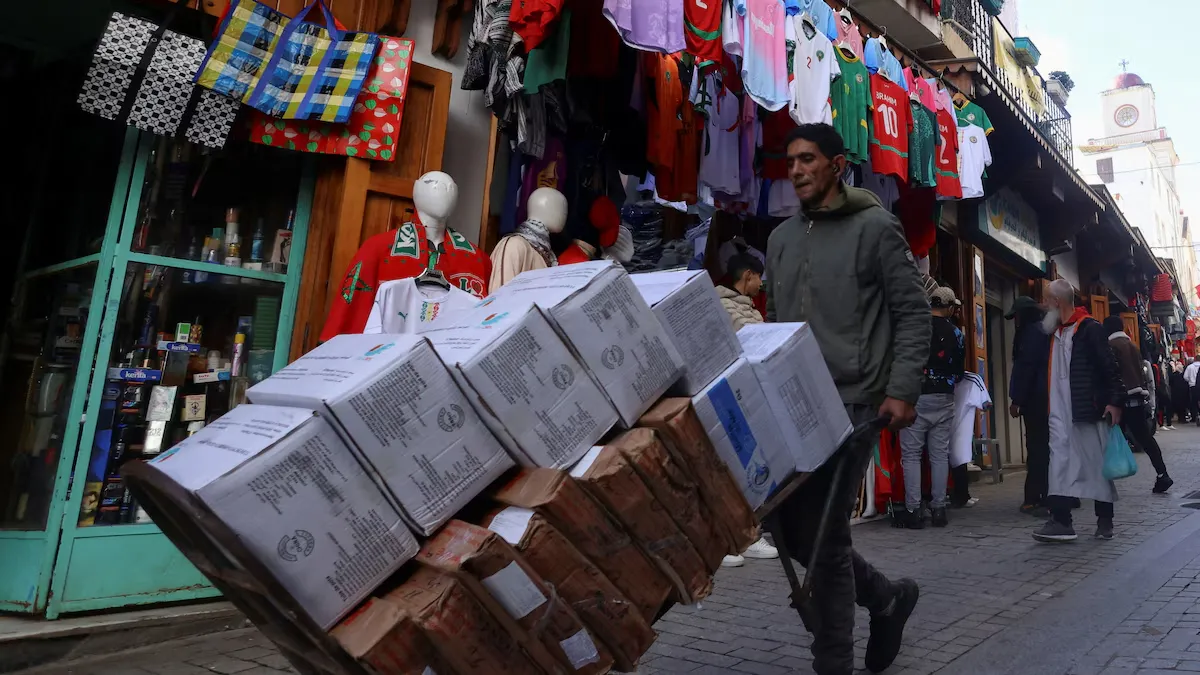
The latest survey by the Haut-Commissariat au Plan on the informal sector, conducted from April 2023 to March 2024, estimates that activities outside formal records and accounting provided employment to 2.53 million individuals in 2023, representing 33.1% of all non-agricultural employment in the country. Within this sector, commerce accounted for 44.1% of jobs, and services comprised another 28.7%. Wage employment was minimal and particularly precarious, with 60% of those working for another person or business lacking a contract. The survey also recorded approximately 2.03 million informal small businesses or production units, an increase of 22% compared to 2014. Of these, 85.5% were operated by a single individual, and only 9.8% were affiliated with Moroccan social security.
As reported by infobae.com.