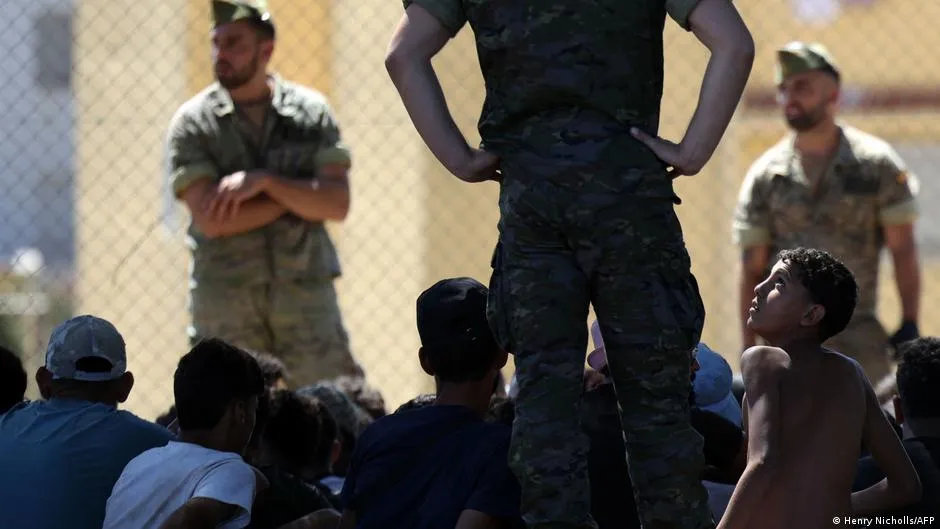

For an extended period, the Moroccan government refrained from commenting on the significant surge of migrants into Ceuta, a Spanish exclave located on the African continent. However, on Sunday, Rachid El Khalfi, a spokesperson for the Moroccan interior ministry, attributed the crisis to what he termed "the malicious exploitation of the digital space," as well as misleading information and misinterpretations stemming from a ruling by the Spanish Supreme Court. Morocco has since clarified that it never intended for such a border surge to occur and has committed to cooperating fully with Spain.
In contrast, Spain was quick to express suspicions regarding Moroccan involvement, with Prime Minister Pedro Sanchez labeling the breach of the border as an "attack on our territorial sovereignty." This suspicion was fueled by videos that surfaced, showing Moroccan security forces failing to intervene as the crowd surged forward across the border.
Various efforts have been made to decipher the underlying causes of this migrant crisis. Some analysts suggest that Spain's recent warming of relations with Algeria may have provoked a reaction from Morocco, while others speculate that there might be some indirect influence from the United States; however, there is no credible evidence to substantiate this latter theory.
A Complex Situation
In discussions with analysts, it becomes clear that the issue is far more intricate than a straightforward explanation would suggest. Isabelle Werenfels, a regional expert on the Maghreb at the German Institute for International and Security Affairs (SWP), points out that the current situation differs significantly from that of 2021, when Morocco sought to exert diplomatic pressure on Spain regarding the Western Sahara conflict. Werenfels states that Morocco stands to lose considerably—particularly in terms of international credibility and investment—if it is found to have deliberately orchestrated the surge of migrants into Ceuta.
Jochen Oltmer, a migration researcher at the University of Osnabrück in Germany, echoes Werenfels's sentiment, cautioning against hasty conclusions while also attributing a significant degree of responsibility to Morocco for the crisis. Oltmer argues that the sheer scale of the border crossing would not have been feasible had Moroccan authorities not chosen to turn a blind eye. He suggests that the inaction on the Moroccan side enabled a breach of this magnitude, thereby contributing to the crisis.
Both analysts acknowledge that Morocco may have aimed to convey a political message to Spain, particularly in light of Spain's recent gestures towards Algeria and its decision to grant citizenship to individuals born in Western Sahara prior to September 1977. However, Werenfels emphasizes the stark distinction between making a political statement and orchestrating a large-scale migration surge, stating that it is "unlikely" that Morocco initially intended the latter, although she does not discount the possibility entirely.
Who Bears Responsibility?
There is emerging evidence suggesting that Morocco may have played a deliberate role in the border surge as a means of advancing its own political objectives. Oltmer notes that Morocco perceives itself as a crucial partner to the European Union in migration policy and has continuously stressed the EU's reliance on its cooperation. The longstanding conflict over Western Sahara, coupled with Morocco's rivalry with Algeria, also factors into this complex equation. Oltmer concludes that it is difficult to envision how the recent events could have unfolded without Morocco's involvement.
Werenfels, however, advocates for a more nuanced understanding, proposing that while Morocco may have intended to send a political message, the situation quickly spiraled out of control. She argues it is implausible for Morocco to desire a lasting rift with Spain and the EU, especially considering its upcoming role in co-hosting the next football World Cup with Spain and Portugal, alongside its dependency on Spanish gas supplies. In 2025, a significant portion of Spain's natural gas exports was directed to Morocco.
Even if Morocco intended to convey a political message, Werenfels cautions that this does not imply a deliberate orchestration of a migration surge of such magnitude, as it would entail considerable political and economic risks. Both experts are in agreement that a third-party influence in the Ceuta migration crisis is unlikely; however, Werenfels acknowledges that other political entities may have attempted to exploit the situation for their own agendas, potentially exacerbating the crisis.
Ultimately, both Oltmer and Werenfels agree on the fundamental reasons behind migration: the quest for hope and better future prospects. With a long history of emigration, many Moroccans are motivated to seek opportunities abroad, bolstered by established family and social networks in Europe. Moreover, Werenfels highlights the significant social and economic challenges still faced by many young Moroccans, particularly in education and healthcare, which compel them to consider migrating in search of a better life.
The Ceuta migrant crisis cannot be attributed to a single political decision or conspiracy, but rather results from a complex interplay of geopolitical tensions, migration policies, and the challenging realities faced by many young Moroccans.
As reported by amp.dw.com.