
Ceuta's Unprecedented Migrant Influx
On July 30 and 31 of this year, the Spanish exclave of Ceuta in North Africa witnessed an alarming influx of up to 80,000 migrants crossing the Moroccan border. This sudden surge overwhelmed a city with a population of only 84,000, leading to a state of emergency that lasted for several days. Essential services such as shops, schools, and restaurants were forced to shut down, while the streets and beaches of the city were filled with refugees seeking food and clothing. The situation raised urgent questions about the security measures in place, particularly since the border is primarily guarded by Moroccan authorities, with only a handful of Spanish security personnel present on the ground.
Initially, the international media speculated about a “lapse” in Moroccan security, with rumors suggesting that the Spanish side may have intentionally allowed the border protection to fail. However, residents of Ceuta firmly believed that the border breach was a deliberate act aimed at destabilizing the city. Despite the strong suspicions, concrete evidence to support claims of orchestrated action by Moroccan officials was initially lacking.
Investigation Reveals Disturbing Insights
Recent revelations, however, paint a different picture. An internal document from the Spanish police, classified under judicial orders, indicates that Moroccan authorities may have indeed orchestrated the border breach. This report, compiled by investigators from the "Policia Nacional," concludes that the breach was premeditated, designed to maintain the facade of an organic migration flow from Morocco to Ceuta, which is a part of Spain and, consequently, the European Union.
The report explicitly states, “The apparent purpose of migration serves merely as a formal cover to facilitate, drive, and direct a massive influx of people to the Ceuta border.” It further details that the migrants received instructions from Moroccan security forces, who were reportedly involved in directing their path through the water and towards the beach. This involvement included both uniformed personnel and undercover operatives blending into the crowd to guide the group.
The investigation raises significant questions regarding the identity of those orchestrating the operation, as the report does not clarify whether these actors were border guards, police officers, or intelligence agents. However, investigators dismiss the possibility that human traffickers or other criminals played a role, suggesting that the level of organization involved exceeds the capabilities of any known criminal networks operating in the region.
Additionally, a local reporter revealed that only the initial migrants swam across the border, while Moroccan security forces subsequently allowed the remaining 80,000 people to pass. This led to chaos among the migrants, including reports of violent altercations.
The findings of the report suggest that the situation escalated into what could be described as a classic offensive counterintelligence operation. A judge involved in the case has indicated intentions to investigate whether these events could be classified as hybrid warfare or a gray zone operation against Spain.
Moreover, the report indicates that Ceuta was not the only target during this breach, as similar attempts were made in Melilla, another Spanish exclave on the North African Mediterranean coast. While the Melilla attempt was thwarted, investigators suggest that it falls within the broader context of the Ceuta incident.
Interestingly, despite implicating Moroccan security forces, the secret police report does not assign blame to the Moroccan government itself. The document highlights the active role of both uniformed and non-uniformed coordinators but does not identify who orchestrated the operation at a higher level, which may explain why Spanish Prime Minister Pedro Sánchez has refrained from making specific accusations against Morocco.
The situation continues to evolve, as recent statements from Sánchez have contradicted the police findings, claiming there was no prior intelligence regarding the impending border breach. However, investigators assert that authorities were aware of increasing migration pressure and had issued risk warnings prior to the event.
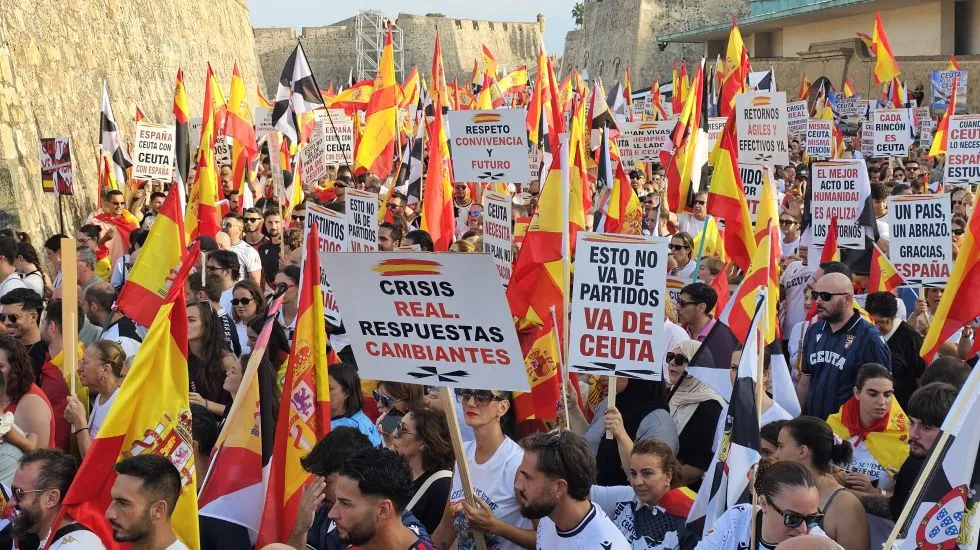
These assertions are corroborated by various classified reports released by the Spanish government, which confirm that officials were indeed forewarned about the looming crisis. This knowledge has contributed to rising tensions between the residents of Ceuta and Sánchez's administration, leading to significant protests in the city where demonstrators branded the Prime Minister a “traitor” and displayed wanted posters featuring his image.
In light of these developments, it is crucial to recognize the historical parallels that may underpin the fears of Ceuta's residents. In 1975, during the so-called “Green March,” Morocco sent approximately 350,000 civilians into the then-Spanish-controlled Western Sahara, aiming to destabilize the region and force Madrid to relinquish control. This historical context remains a poignant reminder of the delicate and complex relationship between Spain and Morocco, particularly in matters of territorial integrity and national security.
As reported by cicero.de.