Massive Protests in Ceuta and Beyond
In the Spanish exclave of Ceuta and on the mainland, tens of thousands of demonstrators gathered on Wednesday to voice their discontent with the Spanish government's handling of the ongoing migration crisis. Participants and speakers accused the central government, led by Prime Minister Pedro Sánchez, of adopting a complacent policy towards Morocco and failing to provide adequate support for Ceuta.
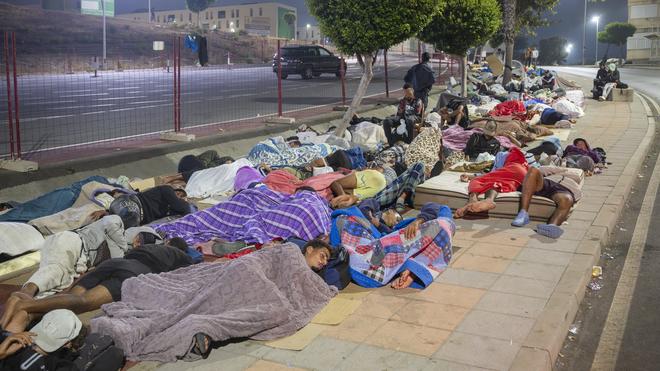
Five weeks after approximately 72,000 migrants swam or climbed over border fences from Morocco to Ceuta, government reports indicate that at least 5,000 refugees, including 1,200 minors, are still struggling in the small city. Many migrants are forced to sleep outdoors on the streets or at beaches, prompting the 80,000 residents of the exclave to utilize an annual holiday to demand a return to normalcy. Some protesters waved Spanish flags alongside banners reading, "Invaders – go home!" Others simultaneously asserted that the tiny Spanish territory, which Morocco has long claimed, should remain under Spanish control.
Demonstrations also erupted in the capital, Madrid, and over 200 other Spanish cities, with citizens protesting against the left-wing Sánchez government's policies regarding Ceuta. The Spanish Municipalities Federation (FEMP), led by the conservative opposition party PP, organized the rallies. The far-right Vox party also joined the protests. "Ceuta is Spanish and will not be abandoned," declared Madrid's conservative mayor, José Luis Martínez-Almeida.
Allegations Against Moroccan Authorities and Government Ignorance
Alberto Núñez Feijóo, the leader of the Spanish opposition party PP, accused Morocco of being partially responsible for the "invasion" of migrants into Ceuta, criticizing Sánchez and his government for denying any responsibility on Morocco’s part. A Spanish police report, obtained by AFP, has also implicated the Moroccan police for their leniency during the influx of migrants in late July. According to the report from Spain's National Center for Immigration and Borders (Cenif), the Moroccan police's response to the mass arrival of migrants was characterized by "complete leniency," as they failed to make any serious attempts to disperse or redirect the crowds at the border.
Numerous migrants reported that the police presence at the Morocco-Ceuta border was significantly lower than usual, a claim supported by satellite imagery. The investigators pointed out that testimonies from migrants and footage from online networks indicated a facilitation of irregular immigration, with migrants consistently stating that police forces not only remained passive but also advised them on specific crossing points.
On the occasion of the September 2 holiday, Juan Jesús Vivas, the administrative head of Ceuta, remarked, "What happened to us was not a migration crisis; it was a violation of Spain's territorial integrity." Local authorities have accused the Spanish central government of ignoring warning signs leading up to the border crossings, which had previously led to violent confrontations among residents due to the migrant situation. Some locals have even set camps on fire in frustration.
In contrast, Prime Minister Pedro Sánchez stated on Monday that neither Spanish security forces nor foreign intelligence partners had provided evidence of Moroccan authorities' involvement. He accused Israel, Russia, and the international far-right of spreading "disinformation" in connection with the Ceuta crisis, a claim that Israel vehemently denied as a "shameless lie."
Spanish Minister for Territorial Policy, Ángel Víctor Torres, described the protests as politically motivated, asserting that they aimed to undermine the Spanish government rather than show support for the city of Ceuta or its residents. This week, the Spanish government announced a relief package of 309 million euros for the exclave.
Between July 30 and 31, over 72,000 individuals reached Ceuta on foot or by swimming from Morocco, with most returning shortly afterward or being sent back. Official Spanish reports indicate that at least 91 people lost their lives during this crisis.
As reported by zeit.de.