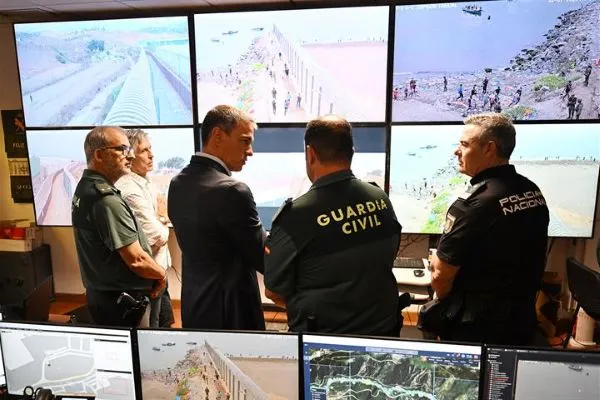
In the wake of massive protests by tens of thousands of Spaniards regarding the government's management of the Ceuta border crisis, Prime Minister Pedro Sánchez found himself grappling with challenging questions from lawmakers, particularly about Morocco's involvement in the significant migrant crossing that occurred in July. While Sánchez dismissed allegations suggesting that Moroccan officials orchestrated the incident, he did acknowledge that Moroccan police had 'allowed the border to be crossed,' a statement that raises concerns about the complicity of Moroccan authorities in this humanitarian crisis.
In a bid to address the growing unrest, Sánchez has promised the release of critical reports surrounding the border breach, although he refrained from providing a timeline for their publication. Notably, he revised the official death toll stemming from the incident to a staggering 141, a dramatic increase from the earlier figure of 96, yet he did not offer clarification on the methodology used to arrive at these numbers. This lack of transparency has further fueled skepticism and anger among the residents of Ceuta, who have witnessed an influx of thousands of migrants into their small community.
The situation has sparked widespread discontent, with protests erupting as citizens demand actionable solutions and some calling for Sánchez's resignation. Opposition leader Alberto Núñez Feijóo from the conservative People’s Party questioned Sánchez directly, asking, 'Why are you afraid of Morocco?' Although the majority of the migrants who entered Ceuta have since returned to Morocco, around 5,000 individuals, including 1,200 minors, remain stranded in the area. Sánchez has attributed the crisis to a misinterpretation of a Supreme Court ruling and the spread of disinformation on social media, even accusing accounts linked to Russia and Israel of manipulating the situation, claims that both nations have denied.
Sánchez has firmly stated that there is no substantial evidence connecting the Moroccan government to the recent surge in migrant crossings. He insisted, 'No institution — be it the diplomatic service, the European Commission, or any international body — has provided solid evidence that Morocco planned or executed the incident.' This assertion comes despite reports from Spanish media indicating that a police document suggested leniency from Moroccan security forces, although officials clarified that this document did not implicate the Moroccan government directly.
During a peak period on July 30, Sánchez acknowledged that Moroccan Gendarmerie police had indeed facilitated crossings, but he emphasized that they later regained control of the situation. As public concern over Morocco’s role in the crisis intensifies, Sánchez reiterated his commitment to awaiting concrete evidence before drawing any conclusions. Furthermore, he condemned Moroccan ministers' remarks that questioned the sovereignty of Ceuta and Melilla, leading Spain to summon Morocco’s ambassador in Madrid. As of now, the Moroccan Foreign Ministry has not issued a statement regarding these recent developments.
As reported by europeaninterest.eu.